

Why Submarine Internet Cables Outperform Satellites
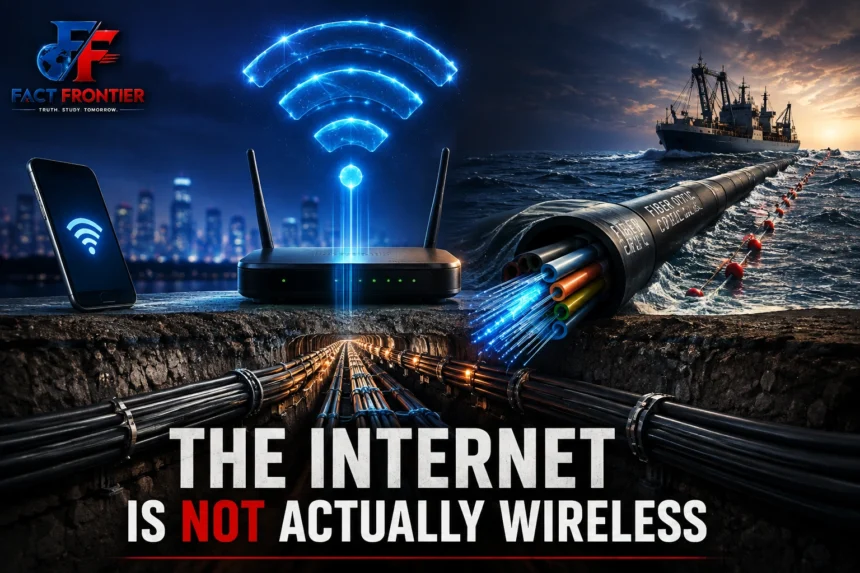
Submarine internet cables carry over 95% of all intercontinental web traffic, quietly resting on the ocean floor while powering our everyday digital lives. When you send a WhatsApp text or stream a 4K video, nothing seems to tether you to the physical world—there are no wires trailing from your pocket, just a small Wi-Fi icon on your screen. Because of that, most of us picture the internet as an invisible cloud floating in the air. The reality is far more grounded, and much wetter.
That makes the internet feel almost like something that exists in the air.
But a surprising amount of it is actually travelling through cables.
Not just a few cables, either. Thousands of kilometres of fibre-optic cables run across the ocean floor, connecting countries and continents. These are known as submarine cables, and they carry more than 95% of intercontinental internet traffic.
So while we may think of the internet as wireless, much of the system behind it is very physical.
What exactly are submarine cables?
A submarine cable is a communication cable that is placed on the seabed to connect different parts of the world.
Most modern submarine cables use fibre-optic technology. Instead of carrying information as electrical signals, fibre-optic cables send data using pulses of light.
Inside the cable are extremely thin strands of glass called optical fibres. Some of them are roughly as thin as a human hair.
It may sound strange that glass can carry something like a video or a message. The process is actually quite clever. The digital information from a computer or phone is converted into signals of light. Those signals travel through the glass fibre at very high speeds. At the other end, the signals are converted back into data that the receiving device can understand.
The glass fibre itself is delicate, of course, so it is surrounded by several protective layers. The amount of protection depends on where the cable is being placed. Cables near the shore usually need more protection because they are more exposed to ships, fishing activity and other possible sources of damage.
Some submarine cables stretch for thousands of kilometres.
Why put internet cables under the ocean?
The reason is fairly simple: the world has oceans between its continents.
India, for example, is separated from Europe by thousands of kilometres. Asia is separated from North America by the Pacific Ocean. If countries want to exchange enormous amounts of information, their communication networks have to be connected somehow.
Submarine cables provide that connection.
When a cable reaches land, it connects to a facility known as a landing station. From there, the data enters terrestrial networks and continues towards its destination.
It is useful to think of the whole system as a road network.
Your phone connects to a local network, much like a small road. That network connects to larger networks, similar to highways. The submarine cable is one of the major routes that allows data to travel between continents.
Of course, data does not travel in quite the same way as a car. It is broken into small pieces, called packets, which can travel through different parts of the network before reaching their destination.
The important point is that there is a physical infrastructure carrying all of this information.
What about satellites?
Satellites are an important part of modern communication, but they do not carry most of the world’s international internet traffic.
They are particularly useful in places where building traditional communication networks is difficult. Satellites are also used for GPS, weather monitoring, television broadcasting and other services.
For moving huge amounts of data between continents, however, fibre-optic cables have major advantages. They can carry enormous amounts of information and provide high-capacity connections between countries.
This is why technology companies such as Google have invested in submarine cable systems. These cables are an important part of the infrastructure needed to support the growing demand for internet services around the world.
So when we hear about the internet travelling through satellites, that is only part of the story. A lot of the heavy lifting is being done much closer to the ocean floor.
“Ever since the first transatlantic telegraph cable was laid in 1858, as detailed in Encyclopaedia Britannica’s subsea cable overview, the world has relied heavily on physical underwater conduits.”
How much data can a submarine cable carry?
The numbers involved are difficult to imagine.
Some modern submarine cable systems can have capacities measured in hundreds of terabits per second. One terabit is equal to 1,000 gigabits.
To understand why such capacity is needed, think about how much we use the internet every day.
Millions of people are watching videos at the same time. Others are playing online games, making video calls, uploading photos, using cloud services, or downloading large files. Businesses are constantly moving information between different countries. More recently, the rapid growth of artificial intelligence has created even greater demand for computing power and data.
All of that information has to travel through networks.
As internet use continues to grow, the infrastructure supporting it has to grow as well. That means new cables are being built and existing technologies are being improved to carry more data.
What happens to the cables on the ocean floor?
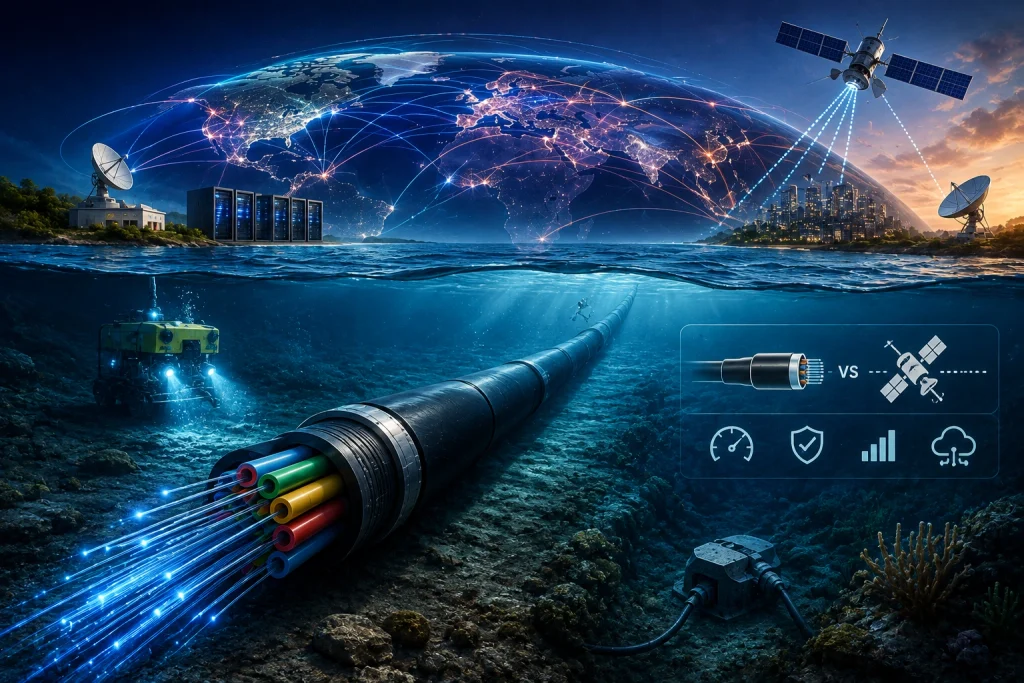
It is easy to imagine a submarine cable being buried deep under the ocean, completely protected from everything around it. The reality is a little different.
Some cables simply rest on the seabed. Others, particularly in shallower waters close to the coast, may be buried or given additional protection.
Even with these precautions, cables can still be damaged.
Ship anchors and fishing equipment are among the risks in areas where there is a lot of human activity. Natural events such as earthquakes and underwater landslides can also damage cables.
Repairing one is a surprisingly complicated operation.
Specialised repair ships have to locate the damaged section, bring the cable up from the seabed and repair it. The repaired section then has to be carefully placed back underwater.
Considering that some cables stretch across entire oceans, it is easy to understand why this is not a quick or simple job.
What if a cable stops working?
Thankfully, the internet does not depend on one giant cable.
There are many submarine cables connecting different countries, often with several possible routes between major regions. If one cable is damaged, internet traffic can often be redirected through another route.
That does not mean a damaged cable has no effect.
If an important connection is disrupted, some areas can experience slower communication or reduced network capacity. In places that have very few international connections, the impact can be much greater.
Tonga experienced a major example of this in 2022. A volcanic eruption and earthquake damaged its main submarine communication connection, causing a significant disruption to communications.
Events like this are a reminder that the internet, despite feeling completely digital, depends on physical infrastructure that can be damaged.
“According to the Internet Society’s global infrastructure research, these underwater routes carry over 95% of international internet traffic.”
What does the “cloud” have to do with all this?
There is another common misconception about the internet: the idea of the cloud.
We often say that our photos, documents and other files are stored “in the cloud.” But the cloud is not some invisible storage space floating somewhere above us.
Cloud services depend on physical computers.
These computers, known as servers, are kept inside large facilities called data centres. Data centres contain thousands of machines that store information and run online services.
When you upload a photo to a cloud service, that photo is ultimately stored on physical hardware somewhere. When you open it later, your device connects to that system through a network.
That network may include fibre-optic cables, routers, data centres and, when information is travelling between continents, submarine cables.
In other words, even something that feels completely digital has a physical side.
The internet is much more physical than it looks.
This is perhaps the most interesting thing about submarine cables.
We use the internet every day without seeing most of the infrastructure that makes it possible. We see a screen, a Wi-Fi symbol and a few buttons. Behind that simple experience, however, is a massive network of physical equipment.
There are servers inside data centres, routers directing traffic, fibre-optic cables running across cities and countries, and submarine cables crossing oceans.
All of these systems work together.
The Internet Society describes the internet as a “network of networks.” There is no single machine somewhere that contains the entire internet. Instead, millions of different networks are connected, allowing information to travel around the world.
That is why the next time you send a message to someone living on another continent, it is worth remembering that the message may be taking quite a journey.
It could move through your local network, pass through several routers, enter a fibre-optic cable, cross an ocean, reach another country and continue through more networks before finally reaching its destination.
We do not see any of this happening.
For us, it is simply a message appearing on a screen.
But behind that simple experience is a huge system of cables, computers, data centres and networks connecting people across the world.
So the next time someone says the internet is completely wireless, there is a surprisingly simple fact you can tell them:
A huge part of the internet is travelling through glass fibres inside cables lying beneath the ocean.
And perhaps that is one of the best reminders that even the most invisible-looking technology in our lives has a very real physical world behind it.
“To see how these routes interconnect across every continent, you can explore the interactive Submarine Cable Map created by TeleGeography.”
Frequently Asked Questions
Q1. How do submarine internet cables actually carry data?
They use thin strands of glass called optical fibers. When you send a file or watch a video, the data turns into pulses of laser light that flash through these glass strands at extreme speeds across the sea. Once the light reaches a landing station on the other side of the ocean, equipment converts the light back into normal digital data for your device.
Q2. Why not just run the entire global internet through satellites?
Speed and volume. Glass fibers in undersea cables carry hundreds of terabits of data every second with almost no delay. Satellites are handy for remote islands or planes, but they cannot handle the massive flood of daily global traffic, and their signals are easily slowed down by bad weather.
Q3. How do crews fix a broken cable miles underwater?
Specialized repair ships track down the exact break by testing light signals through the line. The crew drops a grapnel hook to grab the damaged cable, pulls it up to the surface, and cuts out the broken part. Technicians then splice fresh glass fibers together inside a clean room on the ship before dropping the sealed line back to the seafloor.
Q4. Do sharks actually bite through these cables?
Rarely. While a few shark bites happened on older test lines back in the 1980s, modern deep-sea cables are wrapped in protective steel and tough polyethylene layers. Almost every cable break today is caused by fishing trawlers dragging heavy nets, dropped ship anchors, or undersea landslides.
Q5. Who pays for and owns these undersea cables?
Telecom companies historically joined together to pay for them, but today big tech companies like Google, Meta, and Microsoft fund and build many of their own private routes. They move massive amounts of search, cloud, and video data every day and need dedicated lines across the ocean to keep their services fast.
Also Read:- चांद पर बसने की तैयारी: इंसानों के अगले अंतरिक्ष ठिकाने की कहानी
Ghost Particles (Neutrinos): The Invisible Messengers of the Universe
📚 Verified Research Sources & Fact-Checking Citations
At FactFrontier, every claim is cross-referenced with primary scientific databases, institutional research archives, and verified historical records:
- IEEE Xplore Digital Library: Peer-reviewed computing, telecommunications, and sensor architectures.
- ACM (Association for Computing Machinery): Foundational computer science and network engineering archives.
- MIT Technology Review & Standards Laboratories: Emerging hardware and software benchmark assessments.