
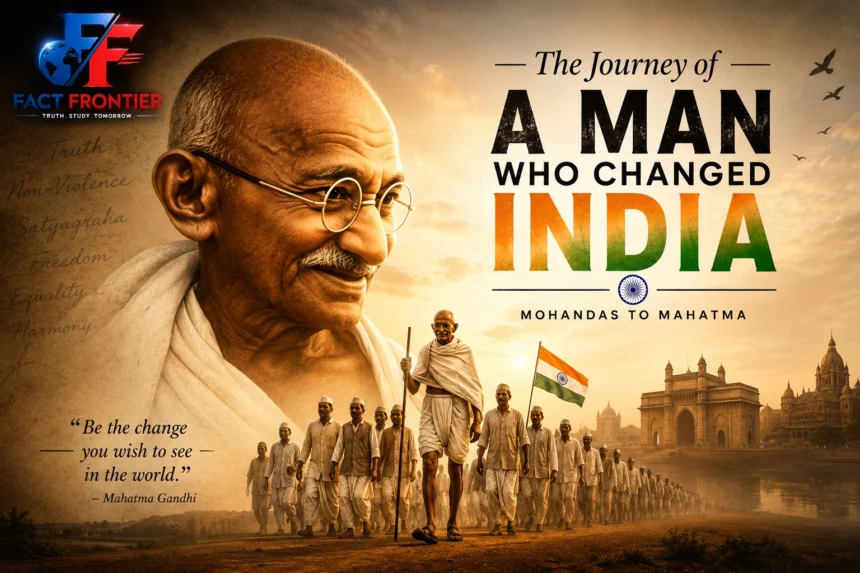
The Journey of a Man Who Changed India
The journey of Mahatma Gandhi is one of the most remarkable transformations in modern history. History often remembers great personalities through the image they left behind—a man dressed in simple khadi, wearing round spectacles, and speaking about truth and non-violence. Yet the central figure of India’s freedom struggle was not born with the title of “Mahatma”; he began his life as Mohandas Karamchand Gandhi, a shy and reserved boy from Porbandar who struggled with confidence, public speaking, and the uncertainties of ordinary life. His journey from Mohandas to Mahatma was shaped by family values, personal experiences, failures, education, racial discrimination, and a growing understanding of injustice. It was a gradual transformation rather than a sudden change.
A Quiet Beginning in Porbandar
Mohandas Karamchand Gandhi was born on October 2, 1869, in Porbandar, in present-day Gujarat. His father, Karamchand Gandhi, served as a Diwan in a local princely state, while his mother, Putlibai, was deeply religious and known for her discipline and devotion. Gandhi grew up in an environment where prayer, fasting, self-control, and religious traditions were part of everyday life. These influences remained with him throughout his life. However, young Mohandas did not appear to possess the qualities people usually associate with a future national leader. He was shy, uncomfortable speaking in public, and generally preferred to avoid attention. He was not known as an extraordinary student, nor was he particularly confident. What later became important, however, was his willingness to examine his own weaknesses honestly. Gandhi did not spend his life presenting himself as a perfect person. He openly discussed his mistakes, fears, and personal struggles, and this habit of self-examination gradually became one of the foundations of his personality.
Marriage and the Search for Self-Understanding
Gandhi married Kasturba Gandhi at a young age, following the social customs of the time. Both were still children when they entered married life. As Gandhi grew older, he began reflecting on his own behaviour and emotions. He later wrote about feelings of jealousy, possessiveness and insecurity during his early years of marriage. These experiences were deeply personal, but they contributed to something that remained with him throughout his life: the habit of questioning himself. Gandhi repeatedly examined his decisions and beliefs and tried to understand whether his actions matched the principles he supported. Long before he became a leader asking society to change, Gandhi was engaged in his own struggle to understand human behaviour, discipline and responsibility.
England and a New Intellectual World
In 1888, Gandhi travelled to England to study law. For a young man from Gujarat, London was a completely different world. Its food, language, clothing and social customs were unfamiliar, and Gandhi initially tried hard to adapt to British society. He paid attention to fashionable clothing and attempted to learn the manners expected of an English gentleman. For a time, he believed that changing his appearance might help him fit into his new surroundings. Gradually, however, he began to understand that identity was not simply about clothes or social behaviour. While living in England, Gandhi encountered different religious and philosophical traditions and began looking at Christianity and Indian religious ideas from a broader perspective. England gave him more than a legal education; it exposed him to a wider world of ideas and encouraged a habit that would remain important throughout his life—the willingness to question accepted beliefs rather than accepting them automatically.
A Struggling Young Lawyer
After completing his legal studies, Gandhi returned to India in 1891. Becoming a barrister was an important achievement, but professional success did not come easily. Gandhi’s early career as a lawyer was disappointing because he was still uncomfortable speaking in public, while courtroom arguments required confidence and quick thinking. On some occasions, he found it difficult even to speak effectively before a judge. The young barrister struggled to establish himself, and his future remained uncertain. It is remarkable to remember that the man who would later address enormous crowds and influence millions of people once struggled with public speaking. Gandhi’s life changed when he received an opportunity to work on a legal case in South Africa. At the time, it appeared to be a professional assignment, but that journey would become one of the most important turning points in his life.
South Africa: The Experience That Changed Gandhi
Gandhi arrived in South Africa in 1893 and soon encountered racial discrimination directly. People of Indian origin faced restrictions and unequal treatment, and Gandhi discovered that education and professional qualifications could not protect him from racism. One of the most famous incidents of his life occurred during a train journey when, despite holding a valid first-class ticket, he was removed from the compartment because of his race at Pietermaritzburg. The experience was humiliating, but Gandhi did not treat it only as a personal insult. Instead, he began asking a larger question: why should people accept injustice simply because it had become part of an established system? He decided to remain in South Africa, and what had begun as a temporary legal assignment gradually developed into a long period of political and social struggle.
The Birth of Satyagraha
During his years in South Africa, Gandhi developed the ideas that would later become closely associated with his name. The most important among them was Satyagraha, a philosophy commonly connected with non-violent resistance but broader in meaning. For Gandhi, Satyagraha meant holding firmly to truth while resisting injustice without using violence. He believed that people did not have to choose only between submission and violent rebellion. They could refuse to cooperate with an unjust system without attacking others. Such resistance required courage, discipline and a willingness to accept consequences. Gandhi organised Indian communities, challenged discriminatory laws and encouraged peaceful resistance. Many participants accepted imprisonment rather than abandon their protest. South Africa transformed Gandhi from a shy lawyer into a political organiser and public leader, while also teaching him that ordinary people could challenge powerful institutions when they acted together.
Returning to India and Understanding Its People
Gandhi returned to India in 1915. By then, his work in South Africa had made him known to many Indians, but he did not immediately place himself at the centre of national politics. He first wanted to understand India and travelled through different parts of the country, observing the lives of ordinary people. What he saw affected him deeply. India was a land of enormous diversity, but it was also marked by poverty, inequality and social divisions. Many farmers lived under difficult economic conditions, while large sections of the population had little political influence. Gandhi gradually realised that political independence alone would not solve every problem. For him, freedom had to be connected with the lives of ordinary people. This understanding would eventually shape the way he approached the national movement.
Champaran and the Rise of a Mass Leader
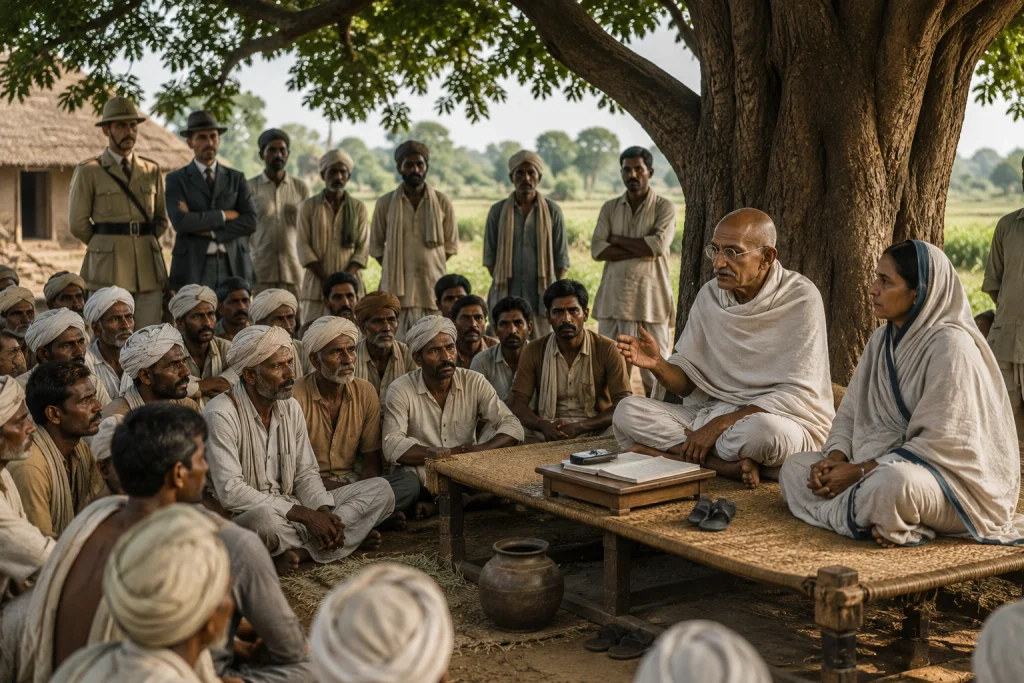
In 1917, Gandhi became involved in the problems faced by farmers in Champaran, Bihar, where many cultivators were suffering under the system connected with indigo cultivation. Gandhi travelled to the region, met the farmers and tried to understand their experiences directly instead of relying only on reports or speeches. When British authorities ordered him to leave, Gandhi refused. His resistance remained peaceful but firm, and he was prepared to face legal consequences rather than abandon the people whose problems he had come to investigate. Champaran introduced India to a different kind of political leader—someone willing to enter villages, listen to ordinary people and place their everyday struggles at the centre of politics. The movement became an important beginning in Gandhi’s emergence as a national leader.
Turning the Freedom Struggle into a People’s Movement
One of Gandhi’s greatest contributions to the Indian independence movement was his ability to involve ordinary people. Before Gandhi arrived at the centre of national politics, political discussions often appeared distant from the everyday lives of farmers and workers. Gandhi changed this by connecting larger political issues with familiar experiences. Through movements such as the Non-Cooperation Movement, he encouraged people to withdraw support from British institutions, while the boycott of foreign goods and the promotion of Swadeshi became part of a broader political campaign. Women, students, workers and farmers increasingly participated in the struggle. Independence was no longer simply a discussion among political leaders; it gradually became a national movement involving people from different sections of society. Gandhi’s ability to communicate played an important role because he could connect complex political ideas with simple symbols and everyday actions.
Khadi, the Charkha and the Idea of Self-Reliance
Gandhi’s spinning wheel, or Charkha, became one of the most recognisable symbols of India’s freedom struggle, but for him it represented more than a political image. It reflected an economic idea based on self-reliance. Under British colonial rule, India often supplied raw materials while manufactured goods were produced elsewhere and sold back to Indian consumers. Gandhi believed that local production could help strengthen communities and reduce dependence. Khadi became closely associated with this idea of self-reliance. Gandhi himself adopted simple clothing, partly as a political statement and partly because he wanted to identify more closely with India’s poor. His appearance became part of his message. In Gandhi’s view, a national leader should not remain completely separated from the people whose interests he claimed to represent.
The Dandi March and the Power of an Ordinary Symbol
In 1930, Gandhi launched one of the most famous protests in Indian history—the Dandi March. The British government controlled the production and sale of salt, and Gandhi chose salt because it was something used by everyone, from wealthy families to poor workers. He began a long march from Sabarmati Ashram to the coastal village of Dandi, and as he travelled, more people joined him. When Gandhi symbolically broke the British salt law, the action carried a powerful political message. A simple substance used in everyday life had become a symbol of resistance. The Salt March attracted international attention and demonstrated Gandhi’s political ability to turn an ordinary object into an issue that millions of people could understand and connect with.
From Mohandas to Mahatma
Over time, Gandhi became known as Mahatma, meaning “great soul.” Yet Gandhi himself did not claim to be perfect. His ideas were debated; he had disagreements with other political leaders, and not everyone agreed with his methods. What gave him a unique place in history was his effort to bring moral questions into politics. Gandhi believed that the methods used to achieve a goal were as important as the goal itself. Truth and non-violence were not simply political strategies for him; they were principles he attempted to apply to his personal life as well. This combination of politics, ethics and personal discipline gradually shaped the public image of Gandhi and contributed to his transformation from Mohandas Karamchand Gandhi into the figure known across the world as Mahatma Gandhi.
Independence, Partition and the Final Years
In 1942, Gandhi launched the Quit India Movement, demanding an end to British rule. His message, “Do or Die,” became one of the most remembered calls of India’s independence struggle. Five years later, India achieved independence, but freedom arrived alongside the tragedy of Partition. Large-scale violence broke out, and millions of people were forced to leave their homes. While many celebrated independence, Gandhi spent much of his time trying to reduce communal violence. For him, political independence had little meaning if Indians continued to kill one another. His final years reflected the same concern that had shaped much of his life—the belief that political progress could not be separated from human dignity. On January 30, 1948, Gandhi was assassinated in New Delhi, bringing an end to his life but not to the influence of his ideas.
Conclusion:
The journey from Mohandas Karamchand Gandhi to Mahatma Gandhi was a long and deeply human journey. Gandhi was once a shy boy, a young man uncertain about his future, and a lawyer struggling to establish himself. He experienced failure, personal weaknesses, and discrimination, but these experiences gradually changed him. South Africa taught him to confront injustice, India showed him the importance of ordinary people, and political struggles demonstrated the power of collective action. Gandhi was not born a Mahatma. He became the person remembered by history through years of experience, reflection, mistakes, and struggle. His life shows that a person’s identity is not permanently defined by where they begin. A shy and uncertain young man from Porbandar eventually became one of the most influential figures of the twentieth century. His transformation—from Mohandas Karamchand Gandhi to Mahatma Gandhi—remains one of the most remarkable journeys in modern history.
Frequently Asked Questions (FAQs)
1. What was Mahatma Gandhi’s early life like before he became a leader?
Mohandas Karamchand Gandhi was born on October 2, 1869, in Porbandar, Gujarat. As a youth, he was quiet, reserved, and struggled with public speaking and self-confidence. He went to London in 1888 to study law, but upon returning to India in 1891, he found it difficult to establish a successful courtroom practice due to his stage fright and shyness.
2. What pivotal event in South Africa changed Gandhi’s life?
The defining turning point occurred in 1893 at the Pietermaritzburg railway station in South Africa. Despite holding a valid first-class ticket, Gandhi was thrown off the train simply because of his Indian ethnicity. The humiliation led him to confront systemic racial prejudice, transforming a shy corporate lawyer into an organized civil rights activist.
3. What does “Satyagraha” mean, and how did Gandhi use it?
Coined by Gandhi during his time in South Africa, Satyagraha literally translates to “holding firmly to truth” or “truth-force.” Rather than passive resistance, it is active, non-violent civil disobedience where protesters willingly face penalties, jail time, and police action without hatred or physical violence, appealing directly to the opponent’s conscience.
4. Why was the Champaran movement of 1917 significant?
The Champaran Satyagraha in Bihar was Gandhi’s first major organized civil resistance in India. He directly investigated the grievances of impoverished tenant farmers forced by British landlords to grow indigo under coercive terms. By refusing colonial expulsion orders and negotiating relief, Gandhi demonstrated that national politics must be anchored in the daily realities of rural India.
5. Why did Gandhi choose salt for the 1930 Dandi March?
Gandhi chose salt because it was an indispensable necessity consumed by every person regardless of class, religion, or caste. By challenging the British government’s heavy taxation and legal monopoly on making salt, he turned a universal household item into a powerful national symbol that united millions in peaceful defiance.
Also Read: – अरब की धरती से एक वैश्विक सभ्यता तक का सफर
📚 Verified Research Sources & Fact-Checking Citations
At FactFrontier, every claim is cross-referenced with primary scientific databases, institutional research archives, and verified historical records:
- Archaeological Survey of India (ASI): Excavation reports, epigraphical records, and monument surveys.
- National Archives & Historical Research Journals: Archival documentation and peer-reviewed historiography.
- UNESCO World Heritage Centre: Cultural landscape and civilization documentation.