
Goosebumps are one of the most intriguing biological reactions our bodies experience. Have you ever felt a sudden chill and noticed tiny bumps appearing all over your skin?
Maybe it happened while listening to a powerful song, watching an emotional scene in a movie, stepping into cold water, or simply walking outside on a chilly morning.
These skin changes are so common that most of us barely notice them. But the strange thing is that your skin is actually reacting to signals from your nervous system.
And there is an even more interesting part: this reaction is a leftover feature from our evolutionary past.
So why does your body still experience goosebumps today?
1. What Exactly Are Goosebumps?
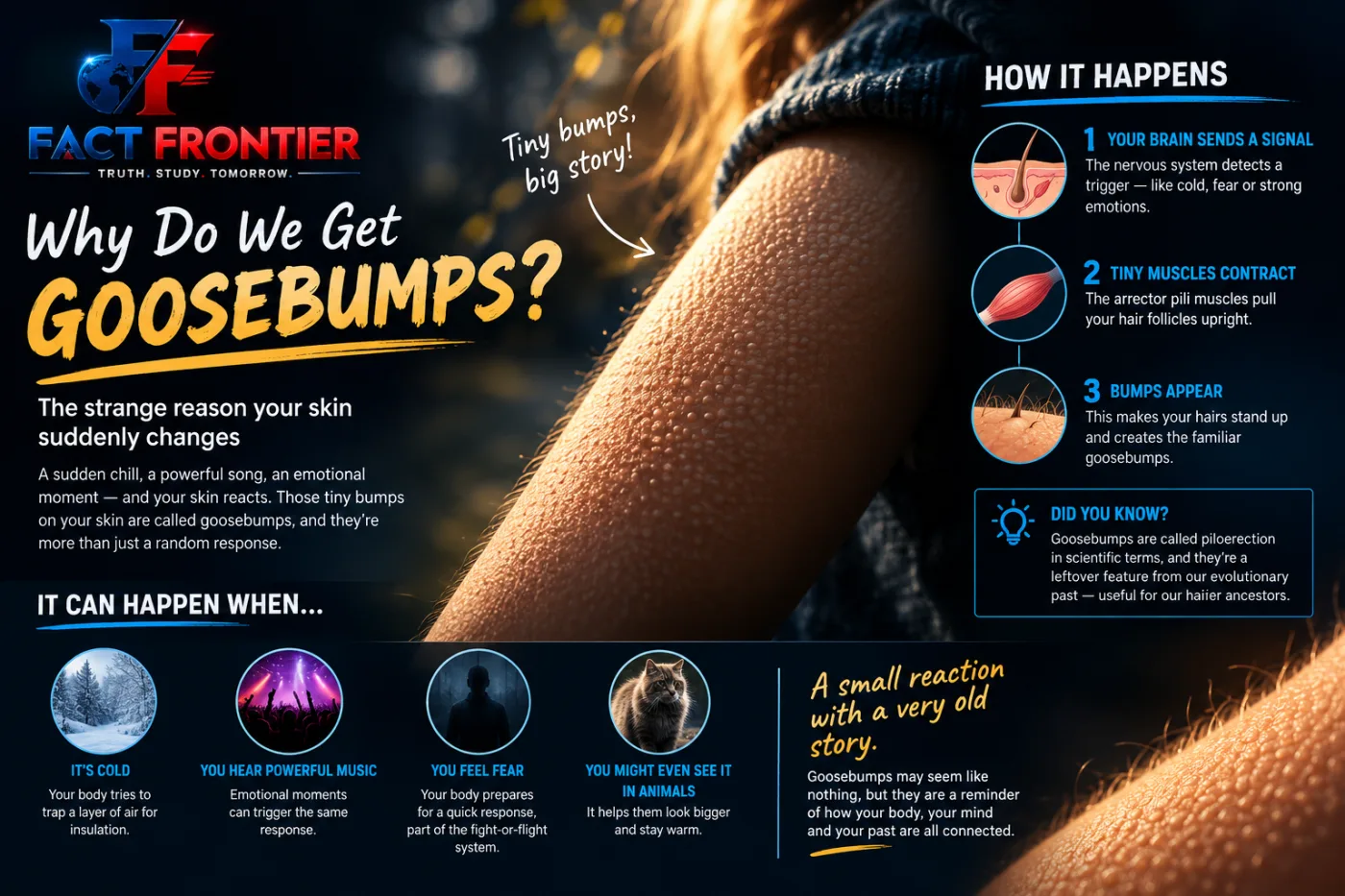
Getting goosebumps happens when tiny muscles connected to the hair follicles in your skin suddenly contract.
These muscles are called arrector pili muscles.
When they contract, they pull the hair follicles slightly upward. This makes the hairs on your skin stand up and creates the familiar little raised spots around them.
The texture is more noticeable in some parts of the body than others, especially when you have little hair covering the area.
The scientific term for goosebumps is piloerection.
It sounds complicated, but the basic process is quite simple: a signal from your nervous system causes tiny muscles around your hair follicles to tighten.
2. Why Cold Triggers This Skin Response
One of the most common triggers for goosebumps is cold weather.
When your body senses that the surrounding temperature is dropping, the nervous system can trigger several responses to help conserve heat.
One of those responses is making the hairs stand up.
For humans, this does not do much because we have relatively little body hair compared with many other mammals. But our ancestors were much hairier.
When their body hair stood up, it could trap a layer of air close to the skin. That layer of air provided insulation against the cold.
In animals with thick fur, the effect is much more useful. Think about a cat standing outside on a cold day—its fur becomes noticeably puffed up. That is essentially an effective version of the same mechanism. Learn more about how human skin functions on Britannica.
3. Emotional Triggers and Fight-or-Flight Responses
You can experience skin chills even when you are completely warm.
Strong emotions can trigger them, too. Fear, excitement, surprise, and intense music can all cause this physical change.
Why?
Because these situations activate the body’s sympathetic nervous system.
This is part of the nervous system involved in the body’s quick-response system, often associated with the “fight-or-flight” response.
When something feels important or intense, your body releases stress hormones such as adrenaline. Your heart rate changes, your attention focuses, and your body prepares to respond. Goosebumps are simply one small part of that reaction. Read more on how the nervous system triggers physical responses at the National Institutes of Health (NIH).
4. The Science of Musical Chills and Frisson
A particular song reaches a certain moment, and suddenly you get chills across your arms.
Scientists study this phenomenon, sometimes called musical chills or frisson.
Unexpected changes in music, emotional moments, anticipation, and the brain’s reward systems all play a role in triggering skin reactions.
For some people, a powerful musical moment activates brain areas involved in emotion and reward. The physical reaction includes chills or raised skin follicles.
Interestingly, not everyone experiences goosebumps from music equally. Some people get chills from music often, while others rarely do.
If a particular song gives you shivers every time, your brain and nervous system are responding to the emotional experience.
5. How Fear Causes Your Hair to Stand On End
Skin bumps also appear when you are frightened.
Imagine hearing an unexpected noise in a dark room. Your brain quickly decides that something might be wrong. Before you fully understand what happened, your nervous system prepares your body to react.
Your pupils change, your heart beats faster, and your muscles become more alert. Tiny skin bumps happen at the same time.
For our distant ancestors, raising the hair made the body appear larger or more threatening to a predator.
For humans today, however, this fear response is mostly a leftover biological reflex.
6. Why Are They Called “Goosebumps”?
The everyday name comes from the way human skin looks when the reaction occurs. The small raised spots resemble the skin of a plucked goose.
Different languages have their own names for the same phenomenon.
In medicine and science, terms such as piloerection and cutis anserina describe this condition.
The term “goosebumps” is simply the much more familiar everyday expression.
7. Can You Voluntarily Cause This Reaction?
For most people, goosebumps happen automatically. You cannot simply decide, “I want my hair to stand up now,” and reliably produce the reaction.
That is because the response is controlled by the autonomic nervous system, which manages functions without conscious control.
However, researchers have studied people who report being able to voluntarily produce goosebumps.
Voluntary control is not considered a normal ability for everyone, and scientists are still studying how this conscious triggering might work.
8. Why This Reaction No Longer Keeps Us Warm
This reaction is one of the best examples of how evolution leaves traces of our past.
It made sense when our ancestors had much more body hair. Today, when you get chilly on a cold morning, the tiny raised hairs do not provide enough insulation to make a major difference.
We have other, more effective ways of dealing with cold, such as reduced blood flow near the skin and shivering.
So goosebumps remain, even though their original thermal benefit is much smaller for modern humans.
9. Are Unexplained Chills a Medical Concern?
Usually, goosebumps are completely harmless.
Getting them from cold, fear, excitement, or strong emotions is a normal body response.
However, if someone experiences unexplained skin chills along with other unusual or concerning symptoms, it is sensible to discuss it with a healthcare professional.
Occasional bumps from cold weather or an emotional moment are generally nothing unusual.
10. A Tiny Reaction With an Ancient Story
While goosebumps look like a random change in your skin, they are connected to some of our oldest survival responses.
A small muscle contracts. Your hair stands up. Your skin forms tiny bumps.
And all of it happens because your body sensed cold, fear, excitement, or another strong stimulus.
For modern humans, goosebumps are no longer as useful as they once were. But they remain a fascinating reminder that the human body carries traces of its evolutionary history.
Also Read- यादें दिमाग में बनती कैसे हैं? जानिए स्मृति के पीछे का विज्ञान
📚 Verified Research Sources & Fact-Checking Citations
At FactFrontier, every claim is cross-referenced with primary scientific databases, institutional research archives, and verified historical records:
- World Health Organization (WHO): Global epidemiological bulletins and public health standards.
- National Institutes of Health (NIH / PubMed): Peer-reviewed clinical research and human physiology studies.
- The Lancet & Nature Medicine: Biomedical review and metabolic research data.