
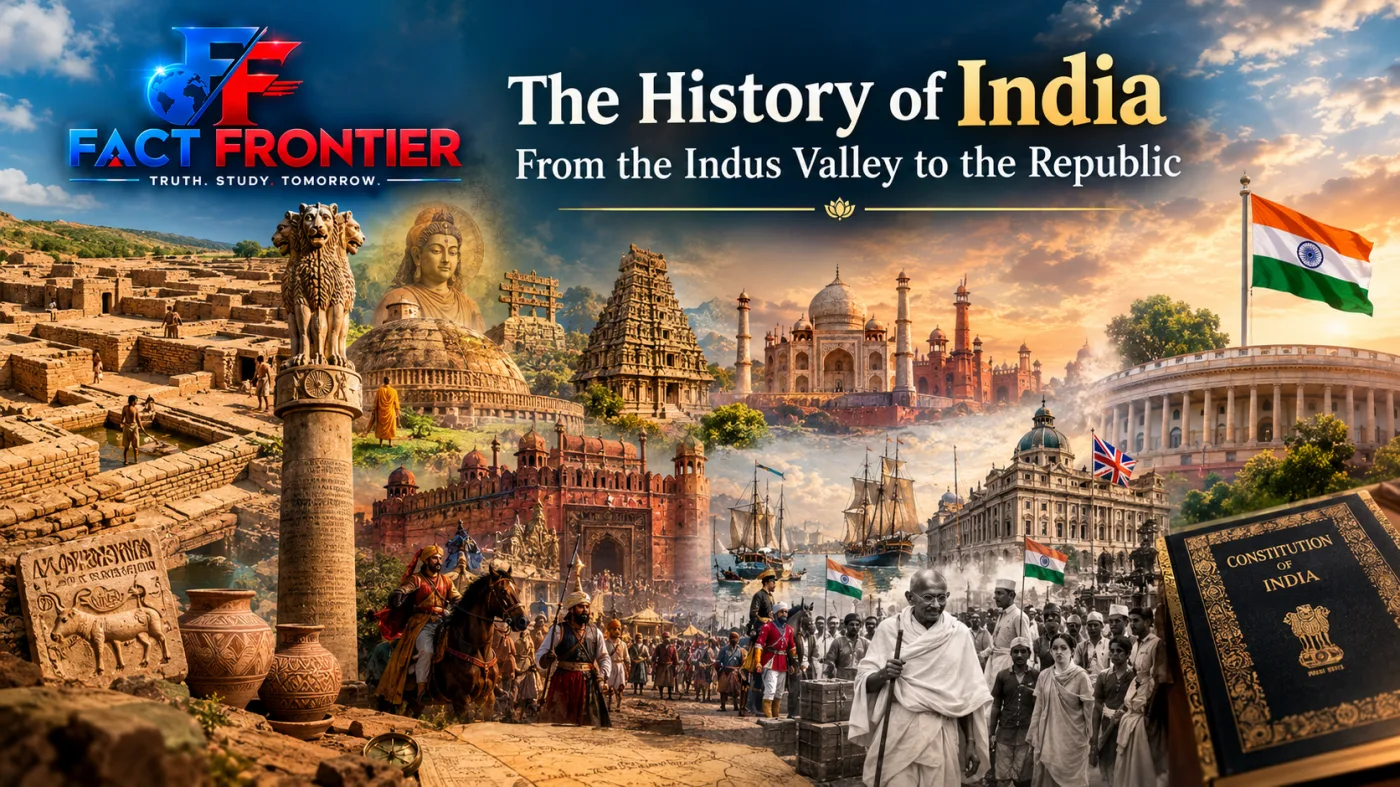
The History of India did not begin with a single kingdom, dynasty, or ruler. It developed over thousands of years through the movement of people, the rise and fall of states, changing religions, trade, scientific knowledge, languages, art, and struggles for political power.
What we now call India was also part of a much larger South Asian region whose boundaries changed repeatedly. Understanding the comprehensive History of India, therefore, means looking at many different societies rather than following only the story of kings and empires.
The Earliest Civilisations in the History of India
Some of the earliest large settlements in the region appeared thousands of years ago. Among the most famous was the Indus Valley or Harappan Civilisation, which developed in parts of present-day India and Pakistan.
Cities such as Harappa and Mohenjo-daro featured planned streets, complex drainage systems, and carefully constructed buildings. Archaeological discoveries also show evidence of craft production and long-distance trade.
The civilisation flourished during the third millennium BCE, although its urban centres later declined. Historians continue to study why this happened, as there is no single explanation accepted for this shift in the History of India. After this period, different communities and cultures developed across the subcontinent.
The Vedic Period and the Rise of New Ideas
The Vedic period is associated with Sanskrit texts known as the Vedas. Over time, social, political, and economic structures changed, leading to larger settlements and kingdoms.
By the first millennium BCE, several mahajanapadas, or large territorial states, had emerged.
This was also a period of major intellectual and religious change in the History of India. Buddhism and Jainism developed in the region, offering new ideas about ethics, society, and liberation. Their influence later spread well beyond the subcontinent.
The Mauryan Empire and Regional Kingship
One of the earliest large empires to control substantial parts of the Indian subcontinent was the Mauryan Empire.
Chandragupta Maurya established the empire in the late fourth century BCE. His grandson, Ashoka, became one of its best-known rulers. Ashoka is particularly remembered for inscriptions placed across his empire. After the Kalinga War, his inscriptions describe a greater emphasis on dhamma, ethical conduct, and concern for living beings.
The Mauryan period is recorded through literary and foreign accounts. For example, Megasthenes, a Greek ambassador, wrote about Mauryan administration. Educational frameworks like NCERT note that such accounts—alongside texts such as the Arthashastra and Buddhist literature—help historians reconstruct this pivotal stage in the History of India.
After the Mauryan Empire declined, different kingdoms and regional powers emerged:
- The Gupta Period: Beginning around the fourth century CE, this era brought major developments in mathematics, astronomy, literature, and art.
- Foreign Accounts: Travellers such as Faxian and Xuanzang left valuable accounts of Indian society during their visits.
Medieval India: A chronicle of Regional Powers
The medieval History of India did not move directly from one empire to another; it saw powerful regional kingdoms across northern, central, and southern India.
- Southern Dynasty: The Cholas developed a maritime empire in southern India and maintained extensive trade connections across Southeast Asia.
- The Delhi Sultanate: From the late twelfth and early thirteenth centuries, several dynasties ruled from Delhi, driving major developments in architecture, administration, languages, and trade.
At the same time, regional states continued to exist across the subcontinent, keeping Indian society culturally diverse rather than controlled continuously by a single central power.
The Mughal Empire in the History of India
The Mughal Empire was established in 1526 after Babur defeated Ibrahim Lodi at the First Battle of Panipat. Over the following centuries, Mughal rulers expanded and reorganized large territories.
- Akbar: Developed an administrative system that helped govern a vast, diverse empire.
- Architectural Legacy: Later rulers, including Shah Jahan and Aurangzeb, presided over distinct phases of political change and major cultural monuments.
Mughal culture developed through an interaction between Central Asian, Persian, and Indian traditions. However, Mughal power did not cover the entire subcontinent continuously. Regional powers such as the Marathas, Rajputs, Sikhs, and Deccan kingdoms played critical roles in shaping the History of India during this time.
European Expansion and the Struggle for Freedom
European traders had visited Indian ports for centuries, but from the seventeenth century onward, European trading companies became increasingly dominant. The English East India Company gradually moved beyond trade to become a military power.
After the Battle of Plassey (1757) and the Battle of Buxar (1764), the Company gained control over key territories and revenue systems. Under British rule, revenues were used to purchase Indian raw materials, shifting India’s economic role toward supplying raw materials and importing manufactured products.
The Uprising and Modern Movement
In 1857, a major uprising began among Indian soldiers and spread across regions. Following the rebellion, the British Crown took direct control in 1858.
The Indian National Congress was founded in 1885. Over time, different political groups developed approaches to gaining self-government:
- Mass Resistance: Mahatma Gandhi promoted non-violent resistance through the Non-Cooperation, Civil Disobedience, and Quit India Movements.
- Complete Independence: The demand for Purna Swaraj (complete independence) was formally adopted at the Lahore session in 1929.
- Diverse Voices: Revolutionary groups, workers, farmers, students, and women all contributed to the wider independence struggle.
Independence, Partition, and the Modern Republic
India gained independence from British rule on 15 August 1947, alongside the Partition of British India, which created India and Pakistan. Partition caused enormous displacement and communal violence, making the transition both a moment of liberation and a severe human ordeal. Official historical archives documented at the National Archives of India record the accelerated timeline that led to independence.
India’s Constitution came into force on 26 January 1950, establishing a republic with a democratic system. The decades that followed brought major changes: economic planning, expansion of education, scientific institutions, industrial development, and agricultural transformation.
For a broader look at modern governance and cultural heritage initiatives, you can explore our detailed guide on Indian Cultural Heritage & Democratic Institutions.
Why Diversity Defines the History of India
There is no single thread that explains the complete History of India. The subcontinent has seen cities and villages, empires and regional kingdoms, migrations, trade, religious movements, and intellectual traditions.
Ultimately, the History of India is not simply a list of rulers and battles. It is the story of ordinary people—farmers, traders, craftspeople, scholars, travellers, artists, and communities—whose lives continuously shaped the modern republic.ellectual traditions.
Also Read: – मौर्य साम्राज्य: चंद्रगुप्त से अशोक तक भारत की सबसे शक्तिशाली कहानी
📚 Verified Research Sources & Fact-Checking Citations
At FactFrontier, every claim is cross-referenced with primary scientific databases, institutional research archives, and verified historical records:
- Archaeological Survey of India (ASI): Excavation reports, epigraphical records, and monument surveys.
- National Archives & Historical Research Journals: Archival documentation and peer-reviewed historiography.
- UNESCO World Heritage Centre: Cultural landscape and civilization documentation.