

The Step-by-Step Science of How Noise-Cancelling Headphones Work
Understanding how noise-cancelling headphones work begins the moment you put on a pair during a flight, on a busy street, or inside a crowded office. The change feels almost immediate. The steady roar of an aircraft engine becomes softer. Traffic fades into the background. The constant hum of an air conditioner seems less distracting.
For a moment, it may feel as though the headphones have somehow removed the noise from the world around you.
That is not exactly what happens.
Noise-cancelling headphones cannot make sound disappear completely. Instead, they use microphones, electronic processing and carefully produced sound waves to reduce some of the unwanted noise reaching your ears. The technology behind this process is known as Active Noise Cancellation, or ANC.
The science itself is based on a familiar property of sound: sound travels in waves. The real achievement lies in the engineering required to measure those waves and respond to them almost instantly.
Sound Is More Than Something We Hear
Every sound begins with vibration. When a person speaks, their vocal cords create vibrations that travel through the surrounding air. A car engine, a fan and a loudspeaker all create similar disturbances in the air, although each produces a different pattern.
These changes in air pressure travel outward as sound waves. When they reach our ears, the eardrum responds to those tiny changes, and the brain interprets them as sound.
Noise-cancelling headphones take advantage of this wave-like behaviour.
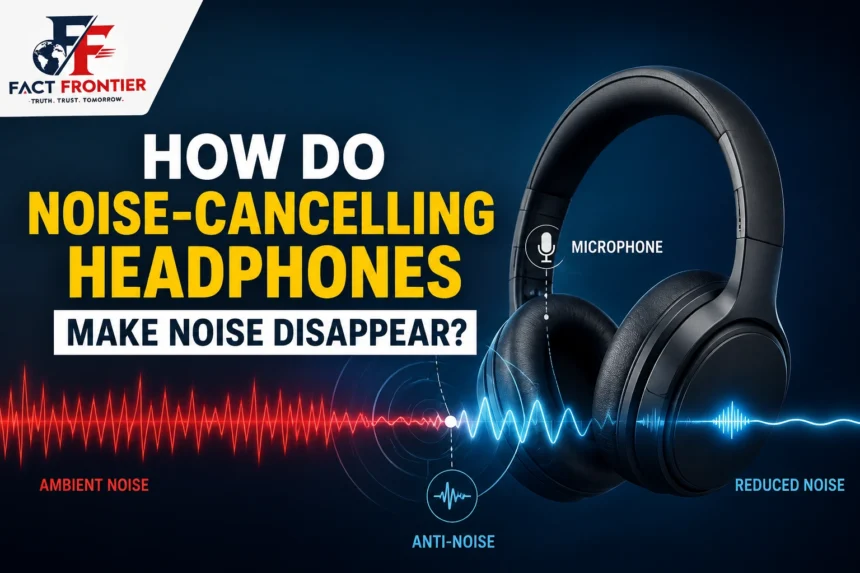
Inside an ANC headphone are microphones that listen to the surrounding environment. The electronic system analyses the incoming sound and creates another sound signal designed to reduce its effect.
This additional signal is often called anti-noise.
The principle sounds simple, but making it work in the real world is far more complicated.
The Basic Idea: Fighting One Wave with Another
A useful way to understand ANC is to imagine waves moving across water.
If two sets of waves meet, they interact. Sometimes their movement combines and creates a larger wave. At other times, one wave can reduce the effect of the other.
Sound waves behave in a similar way.
Noise-cancelling headphones attempt to create a sound wave that is opposite to the unwanted sound entering your ears. When the original noise and the anti-noise meet, the result can be a significant reduction in what you hear.
The headphones are not producing silence. In fact, they are producing additional sound.
That may seem strange at first. To make the environment quieter, the device actually has to create another carefully calculated audio signal.
The success of ANC depends on how accurately and how quickly the system can respond.
The Microphones Are Constantly Listening
Modern noise-cancelling headphones usually contain one or more tiny microphones. Their placement depends on the design of the device.
Some microphones face outward and listen to sounds in the surrounding environment. These are often used to detect noise before much of it reaches the listener’s ears.
Other microphones may be placed inside the earcups or earbuds. They can monitor the sound closer to the ear and help the system understand what is actually reaching the listener.
Many advanced headphones use a combination of both approaches.
The microphones continuously collect information about the environment. The processor inside the headphones then analyses the incoming sound and generates an anti-noise signal.
This process does not happen once.
It happens continuously.
The surrounding environment can change from one second to the next. An engine may increase in speed. A bus may pass nearby. Someone may begin speaking. A door may close.
The headphone system has to keep adjusting to these changes.
All of this happens so quickly that the listener usually has no idea how much processing is taking place.
Why ANC Works Best Against Engine Noise
Anyone who has used noise-cancelling headphones on an aeroplane may have noticed that they are particularly effective against the low, steady sound of an engine.
That is not an accident.
ANC generally works best with predictable and continuous low-frequency sounds. Aircraft engines, train movement, air conditioners and the hum of machinery often produce relatively steady patterns of noise.
Because these sounds continue for longer periods, the headphone system has more opportunity to measure them and create an effective opposing signal.
Sudden and unpredictable sounds are more difficult.
Imagine someone suddenly clapping beside you. The sound appears quickly and disappears quickly. The ANC system has very little time to detect the noise, calculate a response, and produce the anti-noise.
High-frequency sounds can also be more challenging to reduce effectively.
This is why turning on ANC does not usually make conversations disappear completely. You may still hear people speaking, particularly when they are nearby.
Noise cancellation can reduce the background, but it does not create a perfectly silent world.
Active Noise Cancellation and Noise Isolation Are Different
The terms are often used as though they mean the same thing, but they describe two different methods.
Noise isolation is physical. The design of the headphones creates a barrier that reduces the amount of outside sound entering the ear.
An over-ear headphone with thick ear cushions, for example, can block some external noise simply because the material creates a physical seal. In-ear earbuds can do something similar when their tips fit properly inside the ear.
Active Noise Cancellation, on the other hand, is electronic.
It uses microphones, processors, and speakers to reduce unwanted sound.
Most modern premium headphones combine both methods. The physical structure blocks part of the outside noise, while the ANC system works on reducing other sounds.
The result is usually more effective than relying on either method alone.
This is also why the fit of a headphone matters so much. Even the best ANC system cannot completely compensate for a poor physical seal.
Why the Fit of Your Headphones Matters
Noise-cancelling technology works close to your ears. That makes the position of the headphones important.
If an earbud is loose, outside sound can enter through gaps around it. If an over-ear headphone does not sit properly, the ear cushions may not provide effective isolation.
The ANC system can still operate, but it has less control over the total sound reaching your ears.
Manufacturers therefore spend considerable time designing the shape and size of headphones and earbuds. A comfortable fit is not only important for convenience; it can also influence sound quality and noise reduction.
The shape of every person’s ear is different, which is why some devices work better for certain people than others.
A small difference in fit can change the listening experience considerably.
The Headphones Are Producing Several Sounds at Once
When you switch on noise cancellation while listening to music, your headphones are performing more than one job.
First, they are playing the music or audio you actually want to hear.
At the same time, their microphones are detecting environmental noise.
The processor analyses that information and generates an anti-noise signal.
These different sounds are then produced through the headphone speakers. Your ears receive the combined result.
If everything works correctly, the unwanted background noise becomes less noticeable while your music remains clear.
What appears to be a simple pair of headphones may contain microphones, processors, sensors, and specialised software working together in real time.
Why ANC Cannot Create Complete Silence
Real-world sound is complicated.
Noise comes from different directions and changes constantly. Some sounds are steady, while others are sudden. People move, vehicles pass, doors open and close, and the listener’s own position may change.
An ANC system has physical and technological limits.
The headphones must first detect the unwanted sound. They then need time—however small—to process the information and generate an appropriate response.
Perfect cancellation is difficult because the sound reaching each ear can also be slightly different.
The position of the headphones, the shape of the listener’s ears and the type of surrounding noise can all influence performance.
For these reasons, even excellent ANC headphones do not produce complete silence.
Instead, they reduce the noise enough to make the environment feel significantly quieter.
That difference can be especially useful during long flights, while travelling, or when working in a noisy environment.
Why Water and Wind Can Sometimes Affect ANC
Noise-cancelling systems depend heavily on microphones, and microphones can pick up more than just the sounds we want them to detect.
Strong wind, for example, can create pressure changes around the external microphones. This may produce an unpleasant rushing sound or make the ANC system less effective.
Some modern headphones use additional processing to reduce wind noise, but it remains a challenge.
The environment matters.
A quiet room, an aeroplane cabin, and a busy street present completely different acoustic conditions. The system has to adapt to each situation.
This is one reason newer headphones increasingly use adaptive ANC technology. These systems attempt to adjust automatically according to the surrounding environment.
Noise Cancellation Is Not Limited to Headphones
The same basic scientific principle can be used beyond personal audio devices.
Active noise-control systems have been explored and used in vehicles, aircraft, and industrial environments. In some situations, engineers can reduce unwanted noise electronically rather than relying entirely on thick physical insulation.
This approach can be particularly useful when the noise comes from a relatively predictable source.
A vehicle engine, for example, may produce repeated patterns of sound. Electronic systems can analyse those patterns and generate signals designed to reduce their effect inside the cabin.
The technology cannot solve every noise problem, but it offers engineers another tool.
Instead of simply blocking sound, they can attempt to control how sound waves interact.
An Idea That Took Decades to Become Everyday Technology
The scientific principles behind active noise control are much older than modern wireless earbuds.
However, the idea was easier to describe than to implement.
Earlier electronic systems were often too large, expensive or slow for everyday consumer use. Effective noise cancellation requires microphones that can accurately detect sound, processors capable of rapid calculations, and speakers able to reproduce the necessary signal.
Modern electronics changed that.
Today’s devices contain tiny processors powerful enough to perform complex audio processing inside headphones small enough to fit in a pocket.
What once required specialised equipment has gradually become an ordinary feature of consumer technology.
So, Is the Noise Really Gone?
Not completely.
The original sound still exists in the environment. The headphones are not reaching outside and removing the source of the noise.
Instead, they create another sound signal that interacts with the unwanted sound near your ears.
When the two signals are matched effectively, the noise becomes less noticeable.
That is the real beauty of active noise cancellation.
The underlying science is based on a well-known property of waves. The impressive part is the speed and precision with which modern electronics can apply that principle.
The next time you put on noise-cancelling headphones and the steady roar of the outside world begins to fade, it may feel like the device has created silence.
What is actually happening is more interesting.
Your headphones are listening to the noise around you, analysing it in real time and producing another sound designed to push against it.
The world has not suddenly become quieter.
Your headphones have simply learned how to fight noise with sound.
Frequently Asked Questions (FAQs)
1. Do noise-cancelling headphones create 100% complete silence?
No. Active Noise Cancellation (ANC) does not eliminate sound entirely. It creates an opposing “anti-noise” sound wave that neutralizes steady, low-frequency sounds through destructive interference. While it significantly reduces ambient background roar, faint background details and sudden sounds will still be audible.
2. What is the difference between active noise cancellation (ANC) and passive noise isolation?
Passive noise isolation relies on physical materials—such as dense foam ear cushions or silicone ear tips—to block ambient sound from entering the ear canal. Active noise cancellation uses built-in microphones, electronic processing, and internal speakers to actively create counter-sound waves that cancel out noise electronically.
3. Why don’t noise-cancelling headphones block human voices or sudden sounds?
ANC systems work best against predictable, continuous low-frequency noises (like airplane engines or air conditioners). Human speech and sudden noises (like clapping or door slams) are irregular and higher in pitch, meaning the processor does not have enough time to measure, predict, and generate an exact inverted wave before the sound reaches the eardrum.
4. Can active noise cancellation damage your hearing?
No. ANC itself does not emit harmful radiation or dangerous pressure levels. In fact, it can protect hearing over time because it allows users to listen to music, podcasts, or calls at significantly lower, safer volume levels in noisy environments.
5. Why does wind sometimes create a roaring sound in ANC headphones?
Wind causes rapid air pressure fluctuations directly against the external microphones on the headphones. The internal processor misinterprets these physical air movements as high-amplitude ambient sound and generates an opposing signal, resulting in a distinct rushing or fluttering noise.
Also Read: – The Internet Is Not Actually Wireless: Most of It Travels Under the Ocean
How Does Your Phone Know Where You Touched the Screen?
📚 Verified Research Sources & Fact-Checking Citations
At FactFrontier, every claim is cross-referenced with primary scientific databases, institutional research archives, and verified historical records:
- IEEE Xplore Digital Library: Peer-reviewed computing, telecommunications, and sensor architectures.
- ACM (Association for Computing Machinery): Foundational computer science and network engineering archives.
- MIT Technology Review & Standards Laboratories: Emerging hardware and software benchmark assessments.