

Where Were the New Frog Species Found?
New Delhi/Guwahati, August 13, 2026
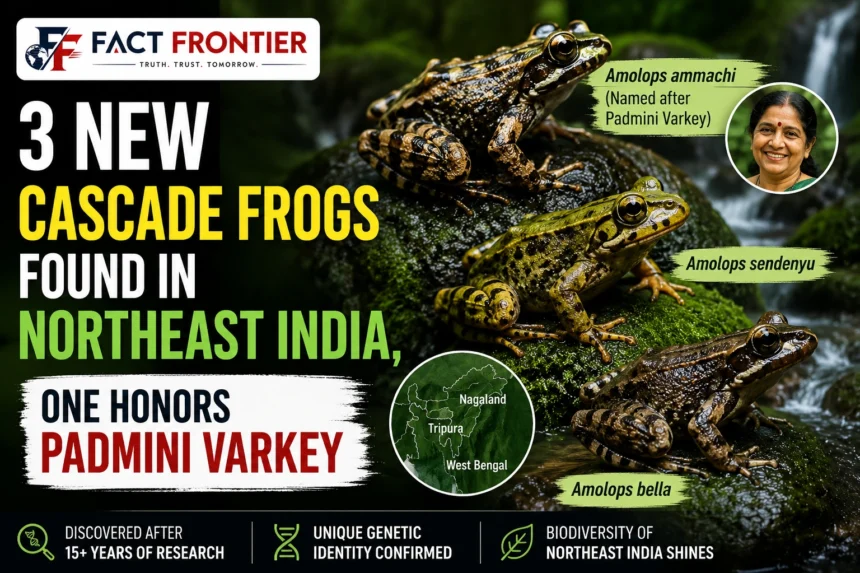
New cascade frog species have been discovered in Northeast India after years of field surveys and scientific analysis, adding to the region’s remarkable amphibian diversity. The three newly identified frogs belong to the genus Amolops and were found in stream and forest habitats across Tripura, Nagaland and West Bengal. One of the species has been named Amolops ammachi in honor of Kerala social worker Padmini Varkey.
The newly identified frogs belong to the genus Amolops, commonly known as cascade or torrent frogs because they are closely associated with rocky waterfalls and fast-flowing forest streams. The discoveries were made in Tripura, Nagaland and West Bengal by a research team led by Delhi University professor S. D. Biju. The findings have been published in the peer-reviewed Bulletin of the Museum of Comparative Zoology, a scientific journal published by Harvard University.
What makes the discovery particularly notable is not just the number of new species. One of them, Amolops ammachi, has been named Ammachi’s Cascade Frog in honor of the late Kerala social worker and philanthropist Padmini Varkey, who was affectionately known as “Ammachi.”
The research also recorded five cascade frog species in places where they had not previously been documented in India and reported five additional species in India for the first time. Together, the findings suggest that the biodiversity of Northeast India’s mountain forests remains far from fully documented.
A Search That Took More Than 15 Years
Finding a new frog species is rarely a matter of spotting an unusual animal during a single field trip.
The research team spent more than 15 years surveying mountainous landscapes across all seven states of Northeast India. Researchers examined more than 300 geographic populations of cascade frogs during the study.
The difficulty lies in distinguishing species that may look remarkably similar.
To establish whether the frogs represented genuinely separate species, researchers combined traditional taxonomic work with modern genetic analysis. They studied the physical characteristics of adult frogs and tadpoles and compared their DNA.
That combination provided the evidence needed to separate three populations from their close relatives and recognize them as species new to science.
The approach is significant because amphibian taxonomy can be complicated by species that share similar appearances yet have been genetically separated over long periods of evolution.
Scientific studies and historical biodiversity records provide important background for understanding the evolution and distribution of amphibians.
The Three New Cascade Frogs
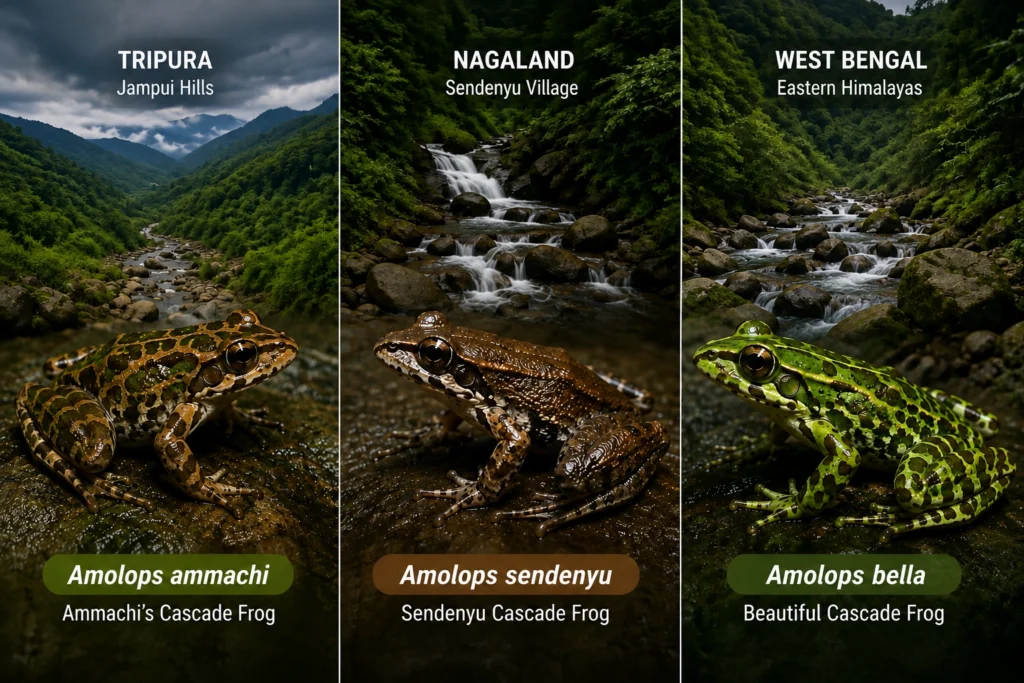
The three newly described species are:
1. Ammachi’s Cascade Frog — Amolops ammachi
This species was discovered in the Jampui Hills of Tripura.
The frog is named after Padmini Varkey, a Kerala social worker and philanthropist who was widely known as “Ammachi.” Researchers chose the name as a tribute to her humanitarian work and her reputation for helping people in need.
Amolops ammachi is a medium-sized frog that can reach around 80 millimeters in length. It has a light-brown body with distinctive olive-green reticulated markings.
The choice of name gives the scientific discovery a human dimension. Scientific species names are often used to recognize researchers, local communities, places, or people whose lives and work have left a lasting impression. In this case, the name preserves the memory of a woman whose work was largely outside the world of zoology.
2. Sendenyu Cascade Frog — Amolops sendenyu
The second species was identified in Nagaland and has been named after Sendenyu village, where it was discovered.
The naming connects the species directly to its geographic origin and highlights the importance of local landscapes in biodiversity research.
3. Beautiful Cascade Frog — Amolops bella
The third new species, Amolops bella, was identified in West Bengal.
It is described as having a striking green body with yellowish-green or reddish-brown mosaic-like patterns. Its scientific name, bella, reflects its distinctive appearance.
The IUCN Red List provides internationally recognized assessments of the conservation status of threatened species.
Why Cascade Frogs Live Around Fast-Moving Water
Cascade frogs are closely linked to streams, waterfalls, and rocky mountain waterways.
These habitats create demanding conditions. Water can move rapidly over rocks, making it difficult for small amphibians to remain in place. Members of the Amolops group have evolved adaptations that allow them to live in such environments.
Their association with clean, flowing forest streams also makes them ecologically interesting. Amphibians are often sensitive to changes in their surroundings, including alterations in water quality, habitat structure and temperature.
For scientists, studying frogs that occupy these specialized environments can therefore reveal more than just the presence of another species. It can also provide clues about the health and history of the landscapes in which they live.
The Discovery Goes Beyond Three New Species
The latest research has produced a broader result than the description of three new frogs.
Scientists documented five cascade frog species from locations where they had not previously been recorded in India. The study also reported five additional species in India for the first time.
That means the research has expanded the known distribution of the Amolops group while also clarifying relationships among species that can be difficult to distinguish.
Such distribution records matter because conservation planning depends on knowing where species actually occur.
A species cannot be effectively protected if scientists do not know that it exists, where it lives, or which environmental conditions it requires.
An Ancient Story Written in Frog DNA
The researchers also looked beyond modern distribution and investigated the evolutionary history of cascade frogs.
DNA-based dating and biogeographic analysis suggest that the group underwent major diversification around 32 million years ago, during the transition between the Eocene and Oligocene geological periods.
This was a period of significant environmental and climatic change in Earth’s history.
The study suggests that cascade frogs underwent several waves of movement across Asia, including dispersal from eastern toward western parts of the continent.
The researchers also identified the early uplift of the Himalayas as an important factor in shaping the group’s distribution and diversification. Their findings point to a complex pattern of movement into and out of the Himalayan region.
In other words, the frogs living beside Northeast India’s streams today are part of an evolutionary story that stretches back tens of millions of years.
Why Northeast India’s Forests Matter
Northeast India sits within two globally important biodiversity regions: the Eastern Himalaya and the Indo-Burma biodiversity hotspot.
The region’s combination of mountains, forests, rainfall and river systems creates habitats for a remarkable range of plants and animals.
Yet much of its biodiversity remains less thoroughly studied than that of some other parts of the country.
The discovery of three new cascade frogs is a reminder that biodiversity surveys can still produce fundamental scientific findings in the 21st century.
It also shows why long-term field research matters. A short survey may reveal an unusual frog, but establishing its identity and evolutionary position can require years of repeated observations, laboratory analysis and comparison with related species.
Discovery Does Not Automatically Mean Protection
Finding a new species is exciting, but it also creates a conservation responsibility.
The newly described frogs are associated with specific stream and forest environments. If those habitats are damaged, the species could face pressures before scientists have even had enough time to understand their populations fully.
Mountain streams can be affected by deforestation, changes in land use, infrastructure development, pollution, and alterations to natural water flow.
This does not mean that the newly discovered frogs are automatically endangered. Their conservation status requires dedicated assessment and further population research.
But the discovery does reinforce a broader lesson: protecting biodiversity begins with knowing what is there.
India’s amphibian diversity continues to be documented through field research and taxonomic studies conducted by institutions such as the Zoological Survey of India.
A Scientific Tribute to Padmini Varkey
Among the three discoveries, Amolops ammachi has attracted particular attention because of its connection to Kerala.

Padmini Varkey worked in the state health service and later devoted much of her life to social and community work, including palliative care. She was associated with organizations involved in women’s welfare, volunteering and social support. She was also remembered for opening her home to people who needed help.
The scientists’ decision to name a newly discovered species after her means that her name will now remain part of the scientific record.
The frog from Tripura’s Jampui Hills and the social worker from Kerala may seem to belong to entirely different worlds. Yet the scientific name Amolops ammachi brings those worlds together.
What This Discovery Tells Us
The three new cascade frogs are small animals, but the questions raised by their discovery are much larger.
How many species remain undocumented in India’s forests? How have the Himalayas shaped the evolution of animals across Asia? How many stream ecosystems remain scientifically unexplored? And how can conservation policy keep pace with discoveries that continue to expand our understanding of biodiversity?
For Northeast India, the answers will require continued fieldwork rather than one-off surveys.
The latest research demonstrates that even familiar-looking groups can contain species that have escaped scientific recognition for generations. It also shows the value of combining field observation, morphology, genetics and evolutionary analysis.
The discovery of Amolops ammachi, Amolops sendenyu and Amolops bella is therefore more than a story about three new frogs. It is evidence that India’s biodiversity story is still being written—and that some of its most important chapters may be hidden beside remote streams in the country’s northeastern mountains.
For science, that is an invitation to keep looking. For conservation, it is a reminder that the forests and waterways being studied today may contain species whose existence is not yet known.
Global biodiversity databases such as GBIF help researchers document and study species distributions across different regions.
Frequently Asked Questions (FAQs)
1. How many new cascade frog species were discovered in Northeast India?
Researchers identified three new cascade frog species in Northeast India: Amolops ammachi, Amolops sendenyu and Amolops bella.
2. Where were the three new frog species discovered?
The species were identified in Tripura, Nagaland and West Bengal. Amolops ammachi was found in the Jampui Hills of Tripura, while Amolops sendenyu is associated with Sendenyu in Nagaland and Amolops bella with the Himalayan region of West Bengal.
3. What are cascade frogs?
Cascade frogs are frogs belonging to the genus Amolops. They are commonly associated with fast-flowing streams, waterfalls and rocky mountain habitats, where they have specialized adaptations for living around running water.
4. What are the scientific names of the three new species?
The three species are Amolops ammachi, Amolops sendenyu, and Amolops bella.
5. Why was one frog named after Padmini Varkey?
The species Amolops ammachi was named in honor of Padmini Varkey, a Kerala-based social worker and philanthropist who was affectionately known as “Ammachi.” The name recognizes her contribution to social and community welfare.
6. How did scientists confirm that these frogs were new species?
Researchers used a combination of field observations, physical characteristics and genetic analysis. Comparing DNA with closely related Amolops species helped scientists determine that the three populations represented distinct species.
7. Why is Northeast India important for frog research?
Northeast India contains mountains, forests, rivers and streams that support exceptional biodiversity. Its location within the Eastern Himalaya and Indo-Burma biodiversity regions makes it an important area for discovering and studying amphibians.
8. How long did the research take?
The research involved more than 15 years of fieldwork across Northeast India, including surveys of hundreds of geographic populations of cascade frogs.
Conclusion
The discovery of three new cascade frog species in Northeast India is more than an addition to the country’s species list. It shows how much remains to be learned about the forests, streams and mountain ecosystems of the region. The identification of Amolops ammachi, Amolops sendenyu and Amolops bella also demonstrates the value of combining long-term fieldwork with genetic and morphological research to uncover biodiversity that can easily remain unnoticed.
The naming of Amolops ammachi after Kerala social worker Padmini Varkey adds a human story to an important scientific discovery. For researchers, the work opens new questions about the evolution and distribution of cascade frogs across Asia; for conservationists, it is another reminder that protecting habitats must begin with understanding what lives within them. Northeast India’s streams may still hold many biological secrets, and continued research could reveal species that science has yet to meet.
Also Read: – World Elephant Day 2026: Why the World’s Elephants Need More Than Just Protection
📚 Verified Research Sources & Fact-Checking Citations
At FactFrontier, every claim is cross-referenced with primary scientific databases, institutional research archives, and verified historical records:
- IUCN Red List of Threatened Species: Global species conservation assessments and population surveys.
- Wildlife Institute of India (WII) & Project Tiger: Field census data and ecological habitat monitoring.
- National Geographic & Zoological Society Research: Ethological observations and biodiversity metrics.