

Ancient Mythology and History of the Vega Lyra Constellation
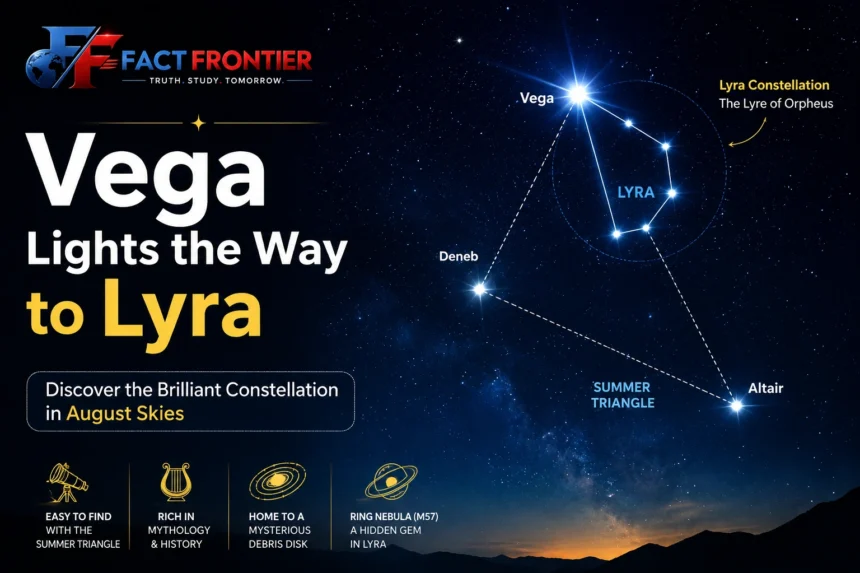
The Vega Lyra constellation pairing offers one of the most striking celestial sights in the clear August sky. Look up after dusk, and Vega’s brilliant, blue-white point of light immediately anchors your gaze, serving as the ultimate guidepost to the rest of the small constellation Lyra.
Look up on a clear August night, and one bright, blue-white point of light is likely to stand apart from much of the surrounding sky. That star is Vega, one of the brightest stars visible from Earth and the easiest starting point for finding the small constellation Lyra.
Finding Vega is only the beginning. Around it lies a patch of sky that connects ancient mythology with modern astronomy, the slow movement of Earth’s axis, the final stages of stellar life and the continuing search for clues about how planetary systems form.
For casual skywatchers, Vega is an easy celestial landmark. For astronomers, it remains a star with unanswered questions.
“Located between Sheliak and Sulafat lies Messier 57 (The Ring Nebula), an expanding shell of glowing gas expelled by a dying star…”
Start With Vega and the Summer Triangle
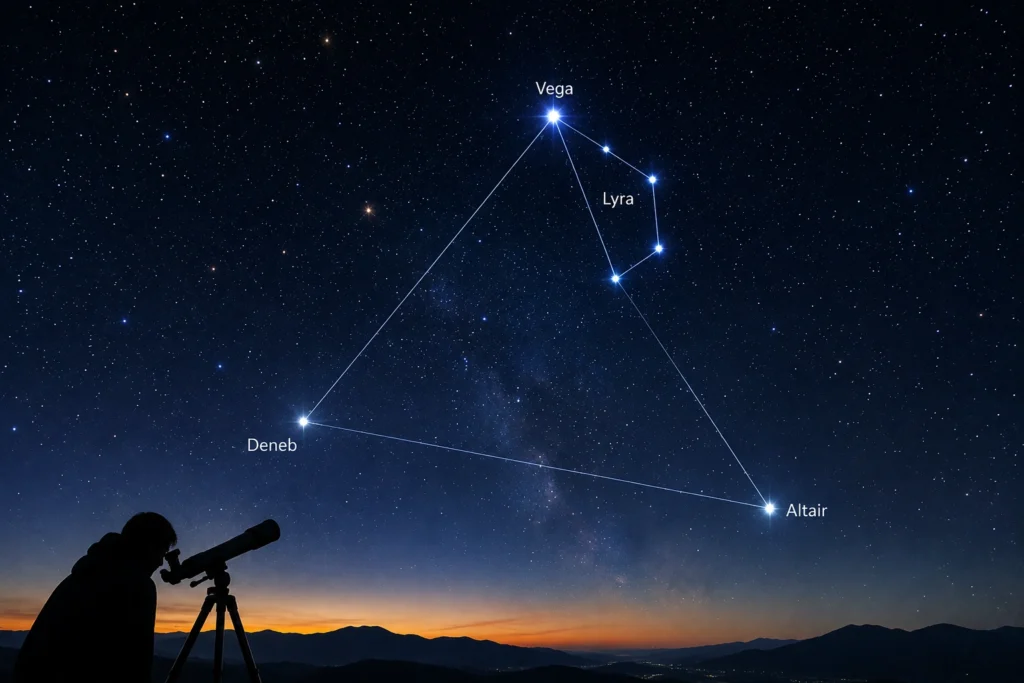
One of the simplest ways to find Vega is to look for the Summer Triangle, a large and easily recognisable pattern dominating northern summer skies.
The triangle is formed by three bright stars: Vega, Deneb and Altair. Vega belongs to Lyra, Deneb marks part of Cygnus, the Swan, while Altair is the brightest star in Aquila, the Eagle.
Once Vega has been identified, Lyra becomes considerably easier to locate. Four fainter stars near Vega form a small parallelogram that makes up the constellation’s most recognisable pattern.
Lyra is not a large constellation. Under heavily illuminated urban skies, some of its fainter stars can disappear into the background glow. From a darker location, however, its compact shape is much easier to trace.
Vega effectively acts as its signpost.
A Constellation With an Ancient Past
Lyra’s story predates modern astronomy by centuries.
It was among the 48 constellations recorded by the Greco-Roman astronomer Claudius Ptolemy in the second century. It later became one of the 88 constellations formally recognised in modern astronomy.
Its best-known cultural association comes from Greek mythology.
Lyra represents the lyre of Orpheus, the legendary musician and poet whose music was said to be powerful enough to charm animals and move even the gods.
The story reflects the way early societies understood the night sky. Constellations were not simply groups of stars. They became part of stories, calendars, navigation and cultural memory.
Different civilisations did not necessarily see the same pictures among the same stars. Astronomical traditions across the world developed their own interpretations, showing how the night sky became a canvas on which cultures placed their own histories and beliefs.
Why Is Vega So Bright?
Vega lies roughly 25 light-years from Earth. It is the brightest star in Lyra and is generally ranked as the fifth-brightest star in the night sky.
Its distinctive blue-white appearance provides an immediate clue to its physical nature.
Astronomers classify Vega as an A-type main-sequence star. It is hotter and more luminous than the Sun and considerably younger.
Its prominence also gave Vega an important place in the history of observational astronomy. For decades, it served as an important reference point for measuring stellar brightness, helping astronomers compare the light coming from other stars.
Yet some of Vega’s most interesting features cannot be seen with the naked eye.
Around the star lies an enormous region of dust and debris, and that material has turned Vega into an important laboratory for studying how planetary systems may evolve.
The Discovery That Changed Vega’s Story
A major chapter in Vega research began in 1984, when observations from the Infrared Astronomical Satellite, or IRAS, detected more infrared radiation from the Vega system than the star alone could account for.
The excess suggested the presence of warm dust surrounding it.
It was a significant discovery. Astronomers had found evidence that material existed around a relatively nearby star, raising an obvious question: could Vega possess a planetary system?
Later observations with telescopes, including Spitzer and Herschel, revealed more detail about the debris around Vega. Scientists began examining whether belts of dust and rocky material could provide clues to processes similar to those that shaped the early Solar System.
Debris disks are particularly useful because their structures can sometimes betray the presence of planets. A sufficiently massive planet can disturb surrounding material through gravity, creating gaps, clumps or other recognisable patterns.
Vega therefore became a natural target for increasingly powerful telescopes.
“Recent high-resolution imaging from the James Webb Space Telescope revealed surprising uniformity across Vega’s 100-billion-mile debris disk…”
Hubble and Webb Take a Closer Look
The Hubble Space Telescope and James Webb Space Telescope have provided some of the most detailed views yet of the material surrounding Vega.
NASA observations show a vast debris disk stretching across roughly 100 billion miles.
What surprised researchers was how smooth much of it appeared.
Astronomers did not find the kind of obvious large-scale gaps that might be expected if massive planets were carving clear paths through the disk. That does not prove Vega has no planets, but it complicates the picture.
Instead of providing a simple answer, the observations have given scientists another problem to solve: why is Vega’s enormous debris disk structured this way, and what does that reveal about the possible architecture of the system?
That uncertainty is part of what keeps Vega scientifically interesting.
Vega Was Once Close to Being the North Star
Vega also has a remarkable connection with Earth.
Today, Polaris is known as the North Star because it lies close to the north celestial pole. But Polaris will not hold that position forever.
Earth’s rotational axis slowly changes its orientation in a process called axial precession. The movement is often compared with the wobble of a spinning top, although it unfolds over thousands of years.
As the direction of the axis changes, the position of the celestial pole shifts against the background stars.
Around 14,000 years ago, Vega was much closer to the north celestial pole than it is today. Thousands of years into the future, the continuing precession cycle will again bring the pole toward Vega’s part of the sky.
The idea offers a useful reminder that the night sky is not as permanent as it appears.
Human lifetimes are simply too short to notice many of its largest changes.
Lyra Holds Another Astronomical Treasure
Once Vega has led an observer into Lyra, there is another famous object worth searching for: the Ring Nebula, also known as Messier 57 or M57.
Despite its name, a planetary nebula has nothing to do with planets. The term is a historical leftover from early telescopic astronomy, when these small, rounded objects sometimes appeared vaguely planet-like through primitive instruments.
The Ring Nebula tells a very different story.
It is the remains of a dying star that expelled its outer layers into space. What remains at its centre is the hot stellar core on its way to becoming, or already existing as, a white dwarf.
Seen through a suitable telescope, M57 appears as a small, ghostly ring. Images from major observatories reveal something far more intricate: expanding gas shaped by the final stages of a star’s evolution.
In that sense, Lyra contains two contrasting stellar stories. Vega represents a relatively young star surrounded by debris that may tell astronomers about planetary-system evolution, while the Ring Nebula shows what can happen near the other end of a star’s life.
How to See Vega in August
No major observatory is required to begin exploring Lyra.
On a clear August evening, start by finding the Summer Triangle. Vega, Deneb, and Altair are bright enough to remain prominent even when many fainter stars are difficult to see.
After identifying Vega, allow your eyes some time to adjust to the darkness and look for the small parallelogram of stars nearby. Moving away from streetlights and brightly illuminated buildings will make the task much easier.
Binoculars can reveal more stars in the area, while a telescope opens the possibility of searching for M57. The Ring Nebula is much fainter than Vega, so dark skies and appropriate equipment make a substantial difference.
A sky-map application can also help identify Vega’s exact direction and altitude from a particular location, since its apparent position changes with time, date and latitude.
For observers in India and elsewhere across much of the Northern Hemisphere, Vega and the Summer Triangle are familiar features of the summer sky.
The Light We See Is Already History
There is another way to think about Vega that requires no telescope at all.
Light does not travel instantaneously.
Because Vega is about 25 light-years away, the light reaching Earth tonight began its journey roughly 25 years ago. Looking at Vega is therefore not seeing the star exactly as it exists at this moment. It is seeing Vega as it was when that light left.
The same principle applies throughout astronomy. The farther into space telescopes look, the farther back in time they are effectively seeing.
That gives this apparently simple August skywatch a much wider perspective.
Vega carries traces of ancient human storytelling. Its changing relationship with Earth’s rotational axis unfolds over thousands of years. Its surrounding debris offers astronomers a chance to investigate the evolution of planetary systems. Nearby, the Ring Nebula provides a glimpse of how stars can end their lives.
From Earth, all of that begins with a single bright point in the night sky.
Find Vega first. Look around it carefully, and the much smaller constellation of Lyra begins to emerge. What appears at first to be little more than a handful of stars turns out to contain stories stretching from ancient astronomy to some of the most advanced observations being made in modern space science.
“Lyra was among the original 48 constellations cataloged by Ptolemy and remains officially recognized by the International Astronomical Union…”
Frequently Asked Questions (FAQs)
1. What is Vega, and why is it important?
Vega is a bright blue-white star about 25 light-years from Earth. It is the brightest star in the Lyra constellation and one of the brightest stars visible in the night sky.
2. How can I find Vega in the August night sky?
The easiest way is to look for the Summer Triangle, formed by Vega, Deneb, and Altair. Vega is usually the brightest of the three.
3. How does Vega help in finding Lyra?
Once you locate Vega, look nearby for four fainter stars forming a small parallelogram. This pattern makes the main shape of Lyra easier to recognise.
4. How far away is Vega?
Vega is approximately 25 light-years away. The light reaching our eyes tonight left the star roughly 25 years ago.
5. Is Vega hotter and brighter than the Sun?
Yes. Vega is an A-type main-sequence star and is considerably hotter and more luminous than the Sun. Its blue-white colour is linked to its higher surface temperature.
6. Does Vega have planets?
Astronomers have not confirmed an Earth-like planet around Vega. However, the star is surrounded by a large debris disk, making it an important target for studying possible planetary-system development.
7. Why is Vega’s debris disk important?
The dust and debris around Vega can provide clues about how material behaves around young stars and how planetary systems may develop. Observations from major space telescopes have helped scientists study its unusual structure.
8. Was Vega ever the North Star?
Vega was much closer to the north celestial pole roughly 14,000 years ago. Earth’s slow axial precession gradually changes the direction of its rotational axis, shifting the position of the celestial pole over thousands of years.
9. What is the connection between Lyra and Greek mythology?
Lyra is traditionally associated with the lyre of Orpheus, the legendary Greek musician and poet. The constellation’s name and shape have therefore been connected with music and mythology for centuries.
10. What is the Ring Nebula in Lyra?
The Ring Nebula, or M57, is a planetary nebula. Despite the name, it has nothing to do with planets. It formed when a dying star expelled its outer layers, leaving behind a hot stellar remnant known as a white dwarf.
Also Read: – Ghost Particles (Neutrinos): The Invisible Messengers of the Universe
📚 Verified Research Sources & Fact-Checking Citations
At FactFrontier, every claim is cross-referenced with primary scientific databases, institutional research archives, and verified historical records:
- Nature & Scientific American Archives: Peer-reviewed science and interdisciplinary research publications.
- Encyclopaedia Britannica & Academic Repositories: Verified historical and encyclopedic reference data.
- Global Scientific Fact-Checking Networks: Primary institutional datasets and peer-reviewed literature.