
Do octopuses dream when their skin shifts into vivid, pulsating colors in the middle of the night? When you think about an octopus, sleeping probably isn’t the first thing that comes to mind. These animals are famous for squeezing through tiny spaces, solving complex puzzles, and changing camouflage in a fraction of a second. But scientists have discovered something even more astonishing: octopuses experience distinct stages of sleep, and during one of them, their bodies behave almost as if they are awake.
Their skin rapidly changes color and texture, their eyes twitch, and their breathing becomes irregular. So, do octopuses dream like humans do, or is there another biological explanation? While scientists cannot give a simple yes-or-no answer yet, recent laboratory research has revealed fascinating clues about what happens inside a cephalopod’s brain during rest.
1. Octopuses Have Distinct Quiet and Active Sleep States
For decades, complex sleep architecture was thought to exist primarily in mammals and birds. However, marine biologists have proven that octopuses experience a surprisingly similar pattern.
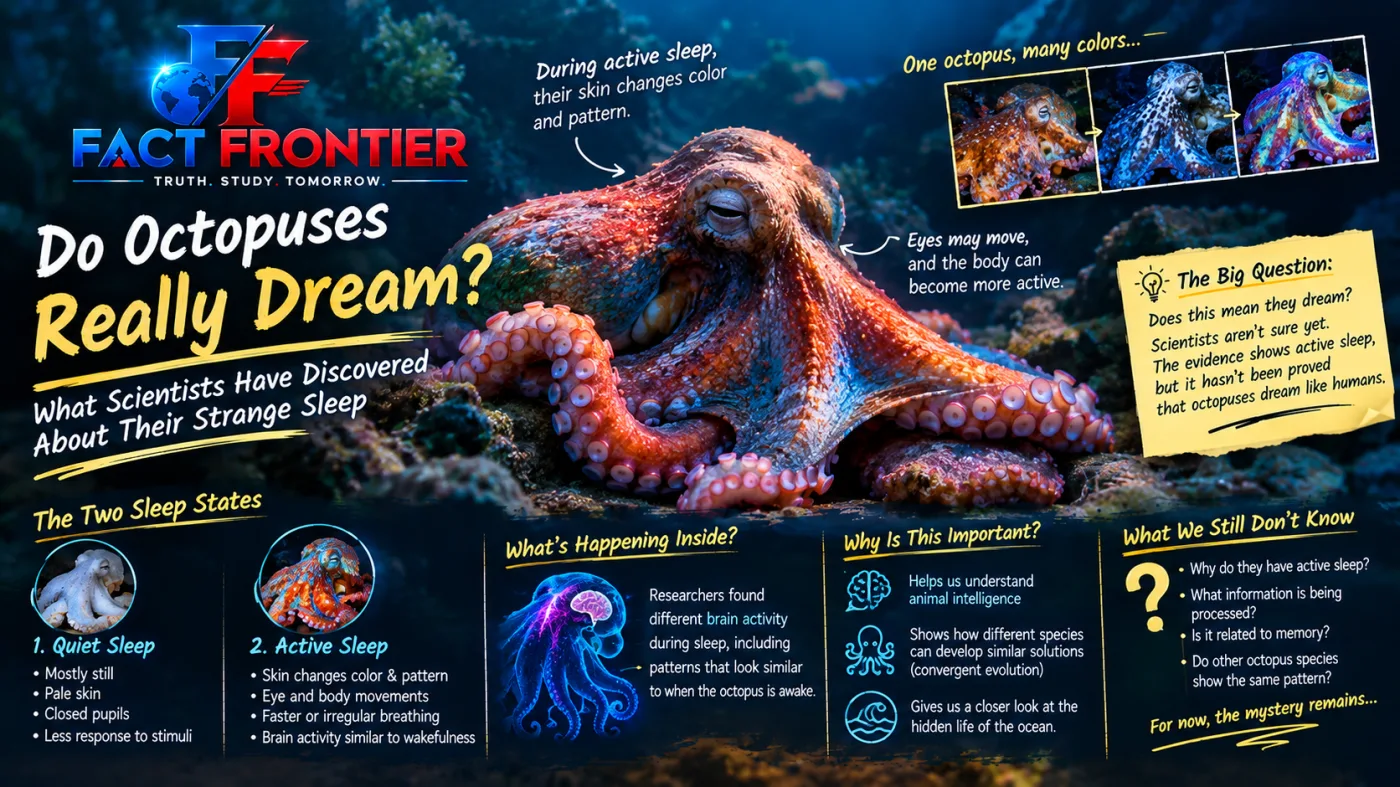
A 2021 study led by Medeiros et al., published in iScience, observed adult Octopus insularis specimens and identified two alternating phases: quiet sleep and active sleep.
- Quiet Sleep: The octopus remains completely still, pale, and unresponsive to mild physical stimuli.
- Active Sleep: The animal twitches, moves its eyes, and rapidly shifts its skin camouflage.
These active sleep periods occur rhythmically, leading researchers to ask: do octopuses dream during these high-activity stages, or are these movements just random physical reflexes?
2. What Happens During Quiet Sleep?
Quiet sleep is the calm baseline of an octopus’s resting cycle. During this phase, an octopus can remain stationary for several minutes at a time. Its skin fades to a pale shade, its pupils contract into narrow slits, and its metabolic activity drops significantly.
To an outside observer, a quiet-sleeping octopus appears completely shut down. However, this calm state serves as a necessary prelude before entering the active stage where many people wonder, do octopuses dream?
3. The Phenomena of Active Sleep
After a period of quiet sleep, the animal transitions into active sleep. This phase typically lasts for about one minute before cycling back to quiet rest.
During active sleep:
- Eye movements become fast and erratic.
- Siphon breathing becomes irregular.
- The body twitches and flexes.
- Thousands of specialized pigment cells, called chromatophores, expand and contract simultaneously.
Because chromatophores are controlled directly by the central nervous system, rapid shifting of skin patterns during sleep indicates intense motor neuron activity inside the octopus brain.
       ┌────────────────────────────────────────────────────────┐
       │               OCTOPUS SLEEP CYCLE PHASE                │
       └───────────────────────────┬────────────────────────────┘
                                   │
                 ┌─────────────────┴─────────────────┐
                 ▼                                   ▼
        [ QUIET SLEEP PHASE ]               [ ACTIVE SLEEP PHASE ]
        • Pale skin tone                    • Rapid color shifts
        • Closed pupils                     • Muscle twitching
        • Low responsiveness                • Wake-like neural signals
4. Scientists Looked Inside the Sleeping Octopus Brain
To explore whether octopuses dream, researchers needed to examine brain function directly. A landmark 2023 study by Pophale et al., published in Nature, recorded brain activity and skin patterning in Octopus laqueus during both sleep stages.
The findings were extraordinary:
- Wake-like Brain Activity: During active sleep, electrical signals in the octopus brain closely mirrored the activity seen when the animal was fully awake.
- Replaying Camouflage: The exact skin patterns displayed during active sleep were almost identical to camouflage patterns used during daytime hunting, hiding, and social interaction.
This discovery led scientists closer to answering: do octopuses dream about their daily experiences under the sea?
5. So, Do Octopuses Dream Like Humans?
When asking, “do octopuses dream?” scientists must remain cautious. Because humans cannot ask an octopus about its subjective experiences, we cannot definitively classify active sleep as dreaming.
Researchers behind recent studies offer three primary explanations for this sleep activity:
- System Maintenance: The brain fires motor neurons to keep skin control circuitry calibrated.
- Memory Consolidation: The octopus processes and stores experiences from the previous day, similar to memory consolidation in mammals.
- Subconscious Replay: The animal experiences a visual or sensory state comparable to animal dreaming.
While the fundamental question—do octopuses dream?—remains open, scientists agree that active sleep plays a vital role in keeping their complex nervous systems healthy.
6. Why Do Octopuses Change Color While Sleeping?
An awake octopus uses its skin for survival—blending into coral reefs, communicating with rivals, or scaring off predators. When these exact patterns reappear during sleep, it offers a rare glimpse into the animal’s internal brain states.
Because skin chromatophores are directly wired to brain centers, the octopus’s body acts like a living video screen. By studying skin changes during active sleep, marine neuroscientists can trace visual memory processing without invasive procedures, shedding light on how octopuses dream and process memories.
7. Convergent Evolution: How Octopus Sleep Differs From Human REM
It is tempting to assume octopus active sleep is identical to human Rapid Eye Movement (REM) sleep. However, humans and cephalopods diverged on the evolutionary tree over 500 million years ago.
This phenomenon is known as convergent evolution—when two distantly related species independently develop similar solutions to biological needs.
| Feature | Human REM Sleep | Octopus Active Sleep |
| Brain Structure | Cerebral Cortex | Central Vertical Brain Lobe |
| Visual Signals | Internal Visuals (Dreams) | External Skin Pigment Shifts |
| Stage Duration | 10 to 60 Minutes | ~1 Minute Cycles |
| Evolutionary Lineage | Vertebrates | Invertebrate Cephalopods |
As highlighted in the Nature Research Commentary on Cephalopod Sleep, both humans and octopuses evolved a two-stage sleep structure independently to manage complex brains and high learning capacities.
Internal Reading & Resources
- Explore our deep-dive analysis on Marine Invertebrate Intelligence and Problem Solving.
- Learn more about How Chromatophores Work in Deep-Sea Cephalopods.
What Remains to Be Discovered
The study of cephalopod sleep is still in its infancy. Scientists are working to determine whether all octopuses experience active sleep, how sleep deprivation affects their learning abilities, and ultimately, whether octopuses dream during memory processing.
What we do know is that a sleeping octopus is far from passive. Its active brain, shifting colors, and complex nerve firings reveal one of the most remarkable evolutionary marvels in the animal kingdom. Whether octopuses dream or simply replay neural patterns, watching them sleep is a window into a truly alien mind.emory processing.
Also read- Street Dogs और Urban Ecosystem: शहरों की छिपी हुई Ecology में इनकी असली भूमिका क्या है?
King of the Jungle का सच: शेर की ताकत और Social Intelligence का Science
📚 Verified Research Sources & Fact-Checking Citations
At FactFrontier, every claim is cross-referenced with primary scientific databases, institutional research archives, and verified historical records:
- IUCN Red List of Threatened Species: Global species conservation assessments and population surveys.
- Wildlife Institute of India (WII) & Project Tiger: Field census data and ecological habitat monitoring.
- National Geographic & Zoological Society Research: Ethological observations and biodiversity metrics.