

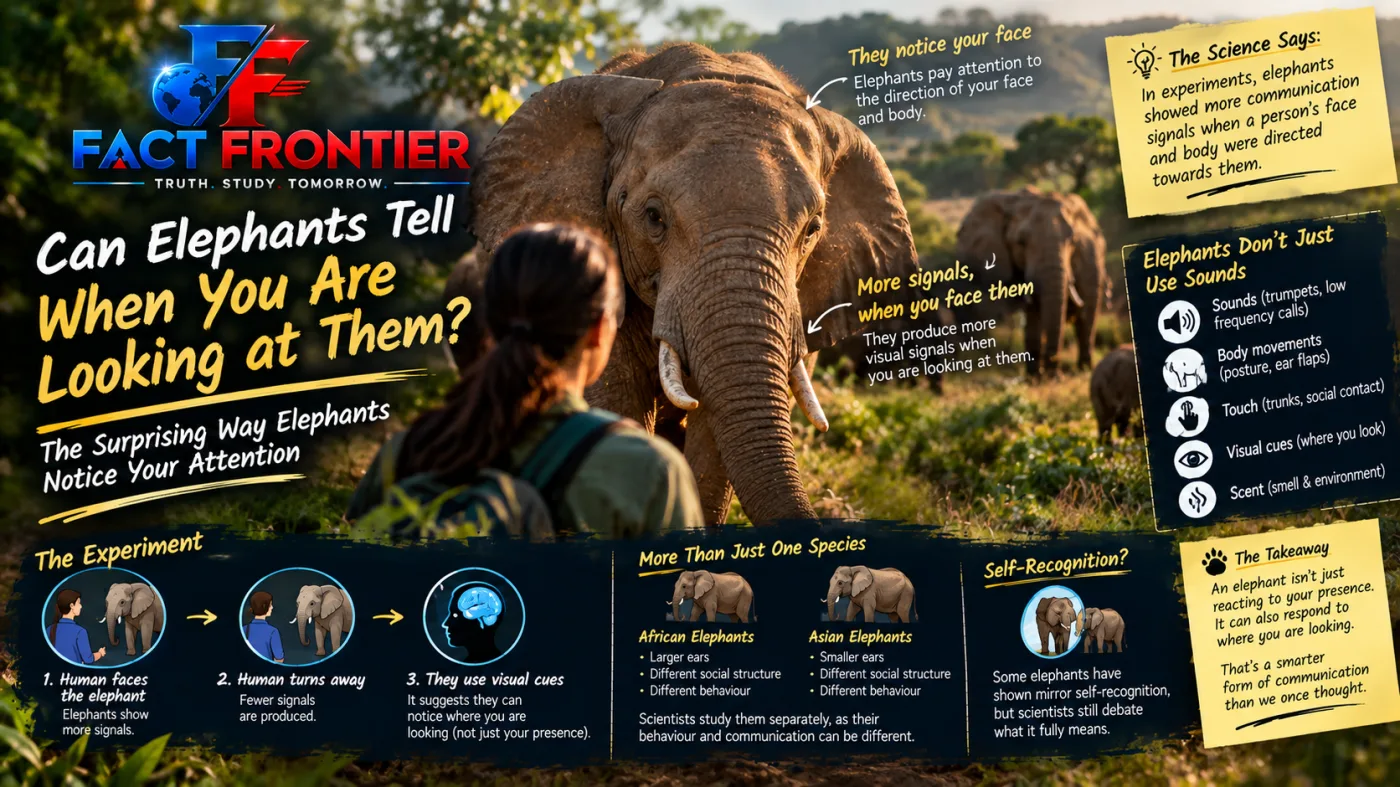
Elephant visual attention plays a fascinating role in how these massive creatures interact with humans and each other.
Imagine standing near an elephant and looking directly at it. The elephant notices you. Now imagine turning your body away while keeping the animal nearby. Would the elephant behave in exactly the same way? Scientists have long been interested in questions like this because communication in animals extends far beyond simple vocalizations or obvious physical gestures. Sometimes, simply knowing where another individual is looking can make a world of difference.
Research into elephant visual attention suggests that these animals pay close attention to the direction of a person’s face and body when deciding how to communicate. In controlled experiments, elephants produced significantly more signals toward people when those people were visibly facing them. That gives us a remarkable glimpse into how a giant mammal—equipped with vast sensory differences—understands the living beings around it.
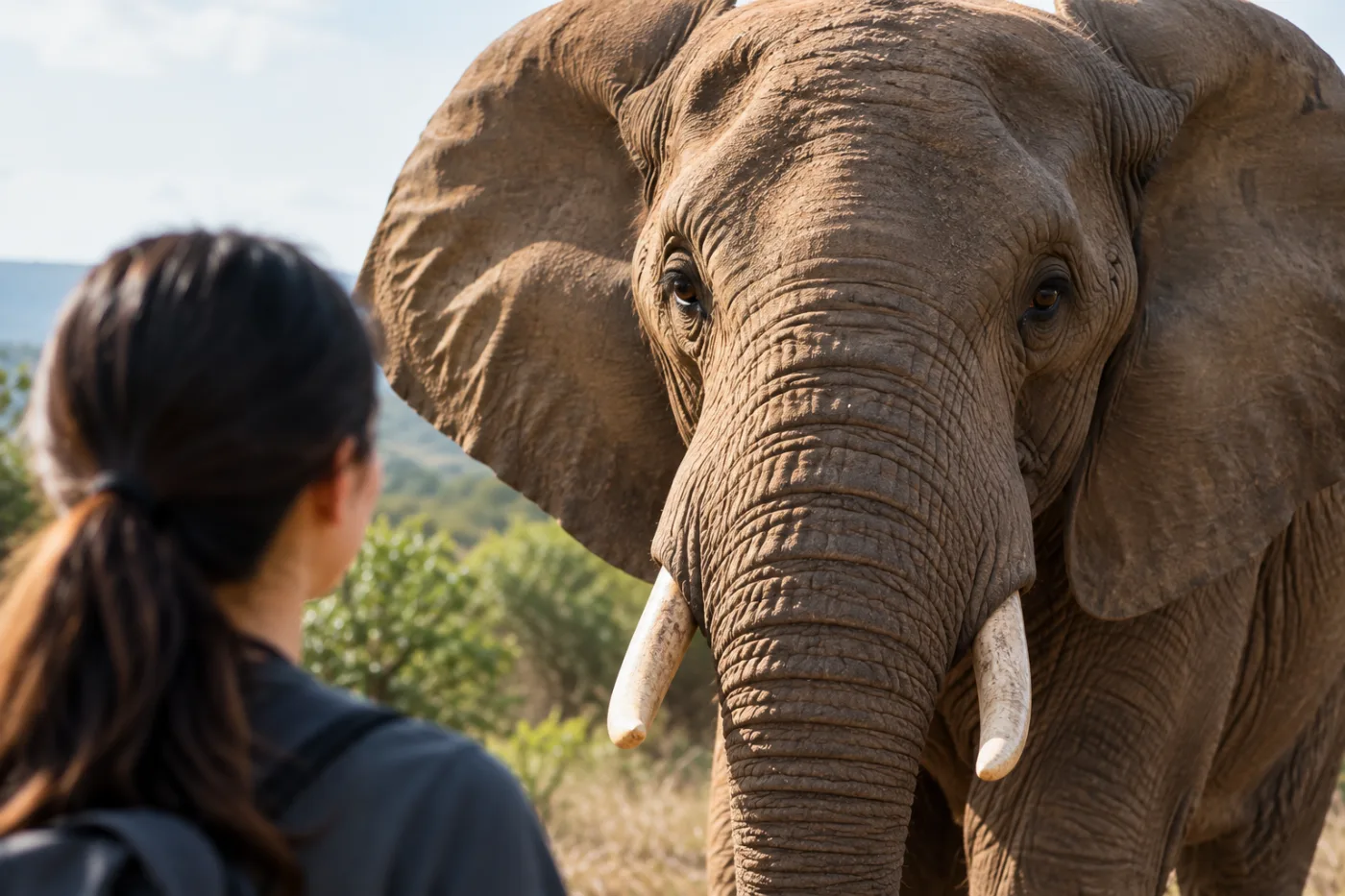
What Is Elephant Visual Attention?
When discussing animal behavior, researchers must be careful. Demonstrating elephant visual attention does not mean proving an animal knows what you are thinking in a human sense. Mind-reading or abstract empathy would be nearly impossible to verify scientifically. Instead, researchers test whether an animal changes its physical behavior based on another individual’s face or body orientation.
For instance, behavioral scientists studied African elephants interacting with a human experimenter who actively shifted position. The researcher would either look straight at the elephant or turn away completely. The elephants produced noticeably more visual signals when the person’s face was directed toward them, particularly when the person’s entire body was aligned with the elephant.
This demonstrates that elephant visual attention serves as a practical, observable mechanism. The animals read visible cues about another individual’s gaze and posture before deciding whether it is worth emitting a gesture or signal. It is evidence based strictly on deliberate behavior rather than blind assumption.
Why Elephants Rely on Visual Cues and Other Senses
When people think about elephant communication, they usually picture the iconic trumpet call echoed across the savanna. However, elephant communication is vast, varied, and multisensory:
- Multisensory Integration: Elephants seamlessly blend sight, touch, posture, and scent to evaluate their surroundings.
- Infrasound Communication: They produce low-frequency rumble sounds that travel miles through the ground and are felt through their sensitive feet.
- Complex Body Language: Ear flaring, head posture, trunk gestures, and subtle tail shifts convey immediate emotional states and social intent.
For a highly social animal living in dense family groups, knowing whether another individual is actually paying attention saves valuable energy. Imagine an elephant trying to visual-signal a herd member facing in the opposite direction; the gesture is wasted if the recipient cannot see it.
The same logic applies to human interactions. If an elephant attempts to initiate contact or request food, relying on elephant visual attention helps it gauge whether a human is receptive. Social dynamics require constant awareness of who is watching whom.
Trunk Movements and Elephant Self-Recognition
An elephant’s trunk adds another dynamic layer to elephant visual attention. Containing tens of thousands of individual muscles, the trunk is used for breathing, smelling, gathering food, drinking, and manipulating subtle objects.
It is also an essential signaling tool. An elephant raises, twists, or points its trunk depending on the context of an interaction. Combined with ear movements, body angle, and vocal sounds, trunk positioning provides surrounding animals with immediate contextual context.
Cognition scientists have taken this research further by investigating whether elephants recognize themselves visually. In a famous 2006 study, researchers introduced a large mirror to three Asian elephants and performed a “mark test.” The animals were given non-irritating visible marks on parts of their heads that they could only see by looking into the mirror.
- Mirror Behavior: The elephants approached the mirror to inspect the marks on their own bodies rather than treating the reflection as a stranger.
- Self-Awareness: At least one elephant repeatedly touched the mark on its head while observing its reflection, offering compelling evidence of mirror self-recognition.
You can read more about these cognitive milestones in the landmark mirror self-recognition study hosted by the National Center for Biotechnology Information (NCBI).
Asian vs. African Elephants: What Research Shows
It is essential to remember that elephants are not a single uniform species. African and Asian elephants possess distinct physical features, behavioral tendencies, and social structures. Scientists study them independently rather than assuming a discovery in one species automatically applies to all.
A 2025 study focused specifically on Asian elephants to evaluate how they interpret human gaze. Ten captive female Asian elephants were monitored while interacting with handlers whose body orientation and head angles were systematically changed.
| Elephant Species | Visual Cue Sensitivity | Primary Communication Drivers |
| African Elephants | High sensitivity to face and full body alignment | Face direction, ear posture, infrasound rumbles |
| Asian Elephants | Strong reaction to combined face/body orientation | Body posture, subtle trunk signaling, tactile contact |
The study confirmed that elephant visual attention plays a strong role in Asian elephants as well. The elephants generated the highest rate of communication signals when both the handler’s face and body were turned directly toward them. Body position served as a foundational visual cue, working in tandem with face direction.
For additional scientific reading on animal cognition and global wildlife conservation, visit the World Wildlife Fund. To dive deeper into related topics on our site, explore our guides on understanding animal body language and how mammal cognition works.
What This Reveals About Wildlife Intelligence
Does an elephant’s ability to read your body position mean it understands human thoughts? Not necessarily. Animals do not need to process human-like internal dialogues to act intelligently.
What the science does prove is that elephants do not merely react to a human’s passive physical presence. Instead, they process live information about where a human’s attention is focused. An elephant standing quietly is actively taking in a massive stream of sensory data—smelling scents on the wind, listening to distant calls, reading posture, and monitoring gaze.
Understanding elephant visual attention reveals that these magnificent creatures are far more visually observant than we once believed, reminding us that wildlife intelligence is rich, complex, and constantly at work.
Also read- क्या हाथी सचमुच कभी नहीं भूलते? जानिए उनकी अद्भुत दुनिया
📚 Verified Research Sources & Fact-Checking Citations
At FactFrontier, every claim is cross-referenced with primary scientific databases, institutional research archives, and verified historical records:
- IUCN Red List of Threatened Species: Global species conservation assessments and population surveys.
- Wildlife Institute of India (WII) & Project Tiger: Field census data and ecological habitat monitoring.
- National Geographic & Zoological Society Research: Ethological observations and biodiversity metrics.