

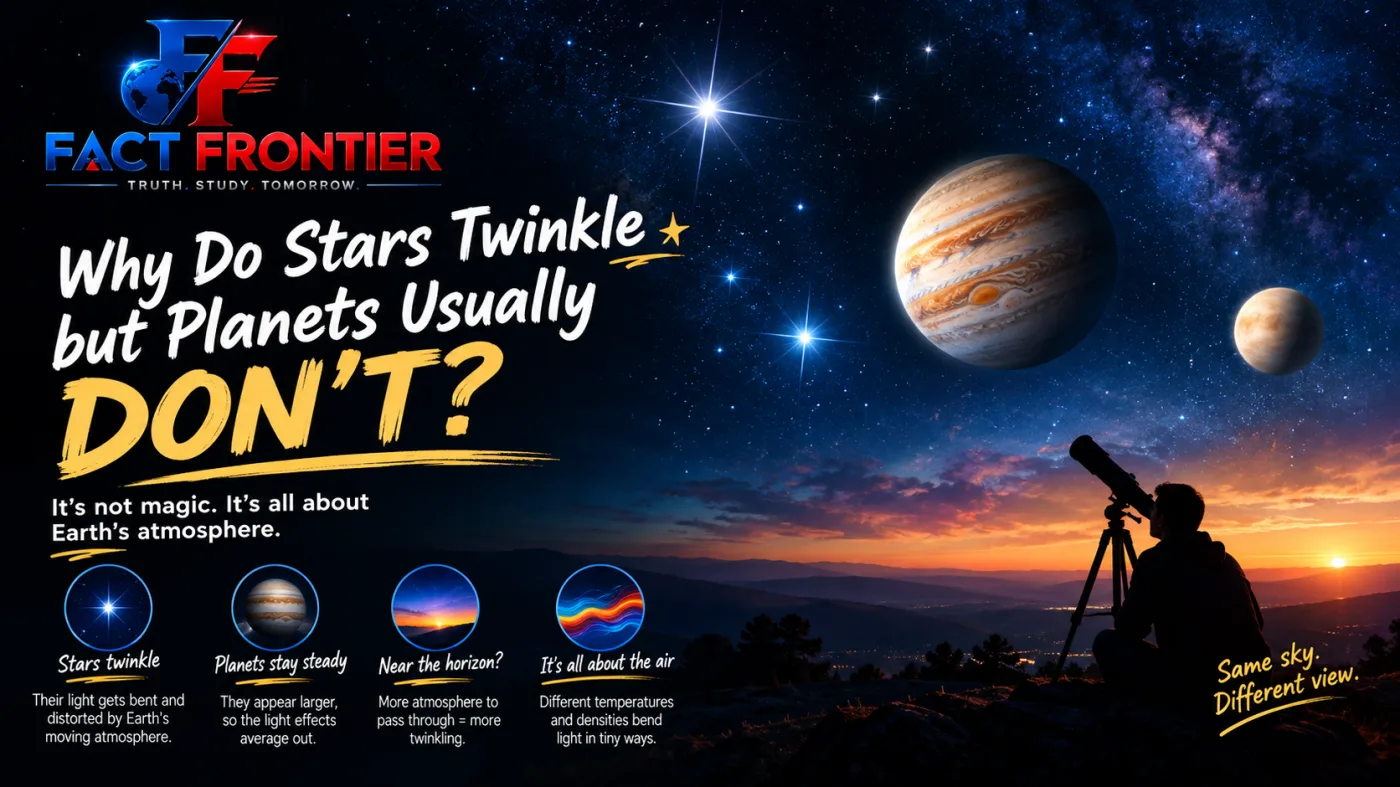
Why do stars twinkle when you look up at the night sky, while planets appear as steady points of light? Look up on a Why do stars twinkle when you look up at the night sky, while planets appear as steady points of light? Look up on a clear night, and you will notice something fascinating: some points of light sparkle, flicker, and change color, while others shine continuously. The short answer to why do stars twinkle comes down to Earth’s moving atmosphere bending their distant light before it reaches your eyes.
Here is a quick overview of how stars and planets compare when viewed from Earth:
| Celestial Object | Apparent Size | Light Path | Twinkling Effect |
| Stars | Point source (Extremely small) | Single, easily disrupted beam | Strong, rapid flickering |
| Planets | Tiny disk (Relatively larger) | Multiple, overlapping beams | Steady (Effects average out) |
| Moon & Sun | Extended disk (Large) | Broad beam | None (Imperceptible distortion) |
Why Do Stars Twinkle in Earth’s Atmosphere?
To understand why do stars twinkle, we have to look at what happens to starlight during its journey. A star produces an enormous amount of light that travels undisturbed through space for billions of kilometers. The disruption begins only when that light enters Earth’s atmosphere.
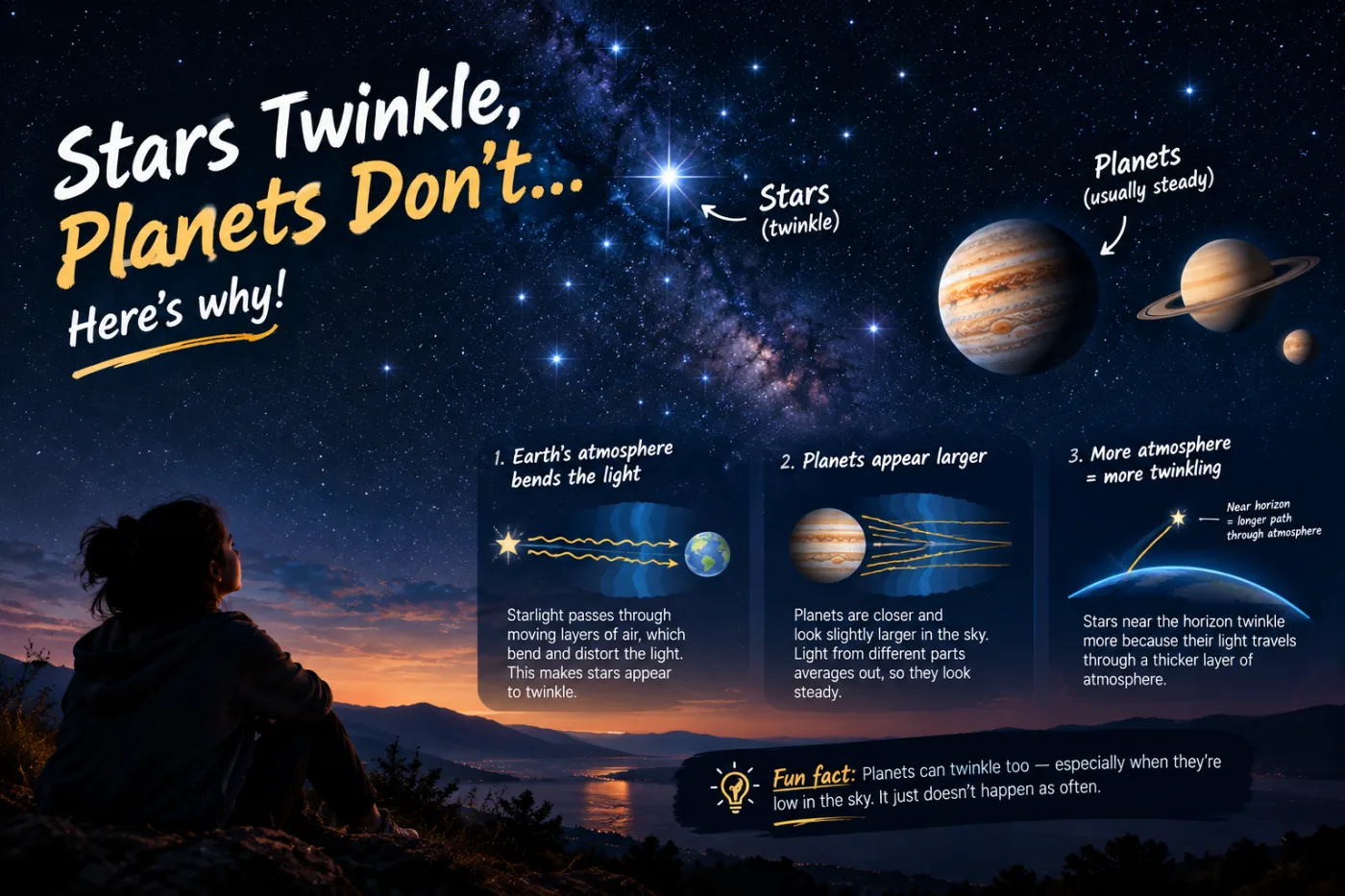
Our planet is wrapped in layers of moving air with varying temperatures and densities. As starlight passes through these turbulent pockets, it undergoes atmospheric refraction—bending slightly in different directions thousands of times per second. By the time it hits your eyes, your brain perceives those rapid position and brightness shifts as twinkling.
For a deeper look into atmospheric optics and space science, explore the detailed breakdown on NASA’s Science Division.
Why Do Stars Twinkle More Near the Horizon?
When asking why do stars twinkle more intensely low on the horizon, the reason is the path length of the light. When you observe stars near the horizon, the twinkling effect becomes dramatically stronger because starlight must travel through a significantly thicker cross-section of Earth’s atmosphere compared to light coming from directly overhead.
- Overhead (Zenith): Shorter atmospheric path, minimal air interference, subtle twinkling.
- Near the Horizon: Longer atmospheric path, maximum air turbulence, intense twinkling and color flashes.
The Real Reason Planets Don’t Twinkle
Planets sit within our solar system, making them much closer to Earth than distant stars. Although a planet looks like a tiny dot to the naked eye, through optical physics, it acts as a disk source rather than a point source.
[ distant star ] -------> ( single light beam ) -------> [ atmospheric turbulence ] -------> [ eyes: flickers ]
[ close planet ] -------> ( multiple light beams ) ----> [ atmospheric turbulence ] -------> [ eyes: averages out / steady ]
Because light arrives from multiple points across the planet’s disk, the atmospheric bends cancel each other out. While one edge of the planet’s light beam is bent away, another edge is bent toward your eye, creating a stable, constant shine.
Do Stars Twinkle in Space?
No, stars do not twinkle in the vacuum of space. The core science behind why do stars twinkle relies entirely on air density changes; without an atmosphere, starlight travels in a completely straight line. Space telescopes like the Hubble Space Telescope and the James Webb Space Telescope capture crystal-clear images without any atmospheric distortion.
Astronomers also use ground-based solutions like adaptive optics—lasers that measure atmospheric distortion in real time so deformable mirrors can correct the blur. Learn more about advanced optical systems through the European Southern Observatory (ESO).
Key Takeaways
- Atmospheric Refraction: Earth’s moving, uneven air layers cause starlight to bend continuously.
- Point Sources vs. Disk Sources: Stars are so far away they act as point sources (easy to disrupt), whereas planets act as disks (disruptions average out).
- Location Matters: Stars flicker much more when low on the horizon due to traveling through more air.
- Space Has No Twinkle: In space, all stars shine with steady, unwavering brightness.
Next time you gaze up at the sky, remember: the answer to why do stars twinkle isn’t happening light-years away in deep space—it is happening just a few miles above your head in our atmosphere.
Frequently Asked Questions
Why do planets sometimes twinkle near the horizon?
When a planet sits very low on the horizon, its light passes through so much atmospheric turbulence that the averaging effect fails, causing it to visibly flicker.
Why do twinkling stars change color?
Earth’s atmosphere acts like a prism, refracting different wavelengths (colors) of light at slightly different angles. Rapid air movement makes bright stars appear to flash red, blue, and white.
How can I tell a star from a planet without a telescope?
Understanding why do stars twinkle helps here: look for steady light versus flickering light. If the point of light shines smoothly without blinking, you are likely looking at a planet like Venus, Jupiter, or Mars.
Read More- 10 Mind-Blowing Facts About Goosebumps: Secrets of Human Chills
📚 Verified Research Sources & Fact-Checking Citations
At FactFrontier, every claim is cross-referenced with primary scientific databases, institutional research archives, and verified historical records:
- NASA Science & Astrophysics Data System: Planetary observational records and deep-space telemetry.
- European Space Agency (ESA): Space mission datasets and astronomical survey documentation.
- International Astronomical Union (IAU): Celestial nomenclature and astrophysical standards.