

Ground Realities from the Santuk Pimpri School Inspection
SANTUK PIMPRI / CHHATRAPATI SAMBHAJINAGAR / By FactFrontier News Desk
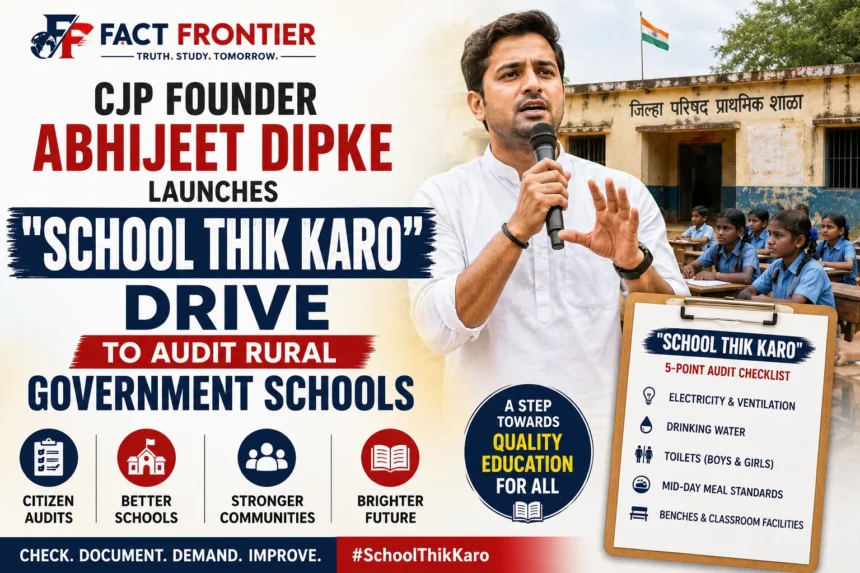
Abhijeet Dipke, founder of the Cockroach Janta Party (CJP), has officially inaugurated a nationwide civic initiative titled ‘School Thik Karo’ (Fix the Schools), beginning with an on-ground social audit at a state-run primary school in his native village of Santuk Pimpri in Maharashtra’s Hingoli district.
The campaign’s rollout on August 15 marks a strategic evolution for the youth-led political platform, pivoting from demonstration-led advocacy in urban centers like New Delhi to decentralized, grassroots inspections of public infrastructure across rural India.
The movement urges parents, village panchayats, and civic groups to audit basic educational amenities, demand institutional accountability, and push for a statutory ceiling on private school tuition fees.
The Santuk Pimpri Audit: Findings on the Ground
Dipke traveled to Santuk Pimpri to attend the village’s Independence Day flag-hoisting ceremony before conducting a walk-through inspection of the local Zilla Parishad school alongside residents, parents, and students.
The on-site assessment documented several structural and sanitary shortfalls:
- Sanitation and Water: The facility lacked running water, with reports indicating that toilets were dry and appeared to have been superficially cleaned just before the visit.
- Classroom Infrastructure: Only four usable wooden benches were available across the primary section, forcing most children to sit on the floor during instruction.
- Improvised Repairs: Broken window panes had not been replaced; instead, damaged frames were covered with political flex banners.
- Digital Inactivity: Desktop units remained non-functional due to maintenance neglect and erratic power supply.
While interacting with students, Dipke documented their grievances about poor road connectivity and unhygienic washrooms. He subsequently presented the findings to the local Sarpanch, who committed to deploying Gram Panchayat resources to address the deficiencies within 7 days.
The ‘School Thik Karo’ Framework: Citizen Audits and the Sarpanch Challenge
The Santuk Pimpri inspection serves as the pilot for a broader, decentralized auditing framework intended to cover primary schools across Maharashtra’s talukas and neighboring states. The campaign operates across two main operational tracks:
1. The 5-Point Citizen Audit Checklist
As reported by coverage in The Times of India and India Today, CJP has distributed a standardized inspection checklist for parents and community volunteers. Citizens are encouraged to visit local state schools, document conditions via photo or video, and submit grievance files to the Block Development Officer (BDO), Headmaster, and Gram Panchayat. The assessment focuses on:
- Reliable grid electricity and ventilation.
- Safe, tested drinking water access.
- Separate, clean, and functional toilets for boys and girls.
- Compliance with Mid-Day Meal nutritional and hygiene standards.
- Adequate student-to-bench ratios and blackboard maintenance.
2. The ‘Sarpanch Challenge’
The platform has called on village heads across the country to take direct administrative ownership of educational facilities within their jurisdictions. Gram Panchayats that proactively repair, sanitize, and equip their schools will have their verified “before and after” operational improvements highlighted across national digital networks to promote competitive local governance.
Read the complete report detailing the school audit findings and demands for private school fee caps in the India Today News Report
Policy Demands and Fiscal Priorities
Addressing journalists in Chhatrapati Sambhajinagar before his village visit, Dipke questioned the broader fiscal priorities of both state and central administrations.
“We have made a new Parliament, a new PM house. Why have we not been able to build new schools in our villages? Do we not consider the children of farmers and labourers the future of our country?”
Dipke pointed to political expenditure during regional rallies, referencing promotional flex hoardings installed during state events in Chhatrapati Sambhajinagar. He argued that public expenditure and political capital should instead be directed toward essential educational infrastructure.
Beyond basic structural upkeep, Dipke highlighted systemic educational trends and reiterated two legislative demands:
- Private School Fee Caps: Establishing state-level regulatory caps on private school tuition fees, which currently range between ₹1,00,000 and ₹1,50,000 in semi-urban pockets, placing an unsustainable burden on lower-income families.
- Halting School Closures: Reversing the administrative consolidation and closure of rural schools—noting that over 94,000 state-run schools have shut down over the past decade—to ensure primary education remains physically accessible within walking distance.
Movement Evolution: From Jantar Mantar to Rural Public Services
The Cockroach Janta Party began as a satirical social media platform before expanding into an on-the-ground youth movement. The group achieved national prominence during protests over competitive examination integrity and recruitment irregularities at New Delhi’s Jantar Mantar.
| Campaign Phase | Primary Focus Area | Target Mechanism |
| Phase 1 (Completed) | Centralized Exam Transparency | Student demonstrations, policy accountability |
| Phase 2 (‘School Thik Karo’) | Primary Education Infrastructure | Village-level social audits, Panchayat remediation |
| Phase 3 (Upcoming) | Rural Healthcare Delivery | Auditing Primary Health Centres (PHCs) & District Hospitals |
Bridging the Urban-Rural Divide in Youth Mobilisation
The strategic transition from centralized agitations to grassroots social audits highlights a conscious attempt by the Cockroach Janta Party (CJP) to bridge the gap between urban student activism and rural developmental challenges. While the initial protests at Jantar Mantar drew largely from university aspirants and urban youth concerned with recruitment leaks and centralized examination integrity, the ‘School Thik Karo’ initiative shifts focus directly to rural education delivery.
By framing public schooling conditions around tangible deliverables—such as running water, functional benches, and clean toilets—the initiative aims to create actionable community pressure at the taluka and village council levels, rather than relying solely on policy appeals directed at central ministries.
Access the national perspective and campaign objectives outlined by The Hindu Special Report.
Expanding Civic Audits to Public Healthcare
The platform has confirmed that the social audit framework established for schools will soon expand to government-run healthcare facilities across semi-urban and rural areas.
According to CJP convenor Abhijeet Dipke, the upcoming healthcare monitoring phase will focus on structural bottlenecks in state hospitals and Primary Health Centres (PHCs):
- Patient Overcrowding: Documenting instances of patients being accommodated on hospital floors due to acute bed shortages.
- Diagnostic & Surgical Backlogs: Addressing procedural wait times, with specific focus on critical imaging delays where patients often wait up to a week for CT scans.
- Essential Supply Chains: Monitoring recurring shortages of life-saving medicines and basic ward sanitation standards.
The healthcare initiative will adopt the same methodology used in the school campaign: standardized reporting templates, citizen-recorded video documentation, and direct submissions to district health officers and local administrative bodies.
Institutional Accountability and Systemic Follow-Through
The long-term impact of the ‘School Thik Karo’ campaign will hinge on administrative responsiveness beyond the initial media attention. While community documentation can identify gaps, structural remediation requires active coordination among village panchayats, block development offices, and state education departments.
The 7-day remediation timeline committed to by the Santuk Pimpri Gram Panchayat will serve as the first test case for whether citizen audits can produce measurable improvements in local public infrastructure.
Review the campaign’s focus on rural education neglect and political expenditure priorities on the India Today Education Portal.
Frequently Asked Questions (FAQs)
Q1: What is the ‘School Thik Karo’ campaign?
A: ‘School Thik Karo’ (Fix the Schools) is a citizen-driven social audit initiative started by Cockroach Janta Party (CJP) founder Abhijeet Dipke. It focuses on identifying and resolving basic infrastructure deficiencies in government schools across rural areas, including clean toilets, safe drinking water, electricity, and classroom seating.
Q2: When and where was the campaign launched?
A: The initiative was launched on August 15 (Independence Day) from Santuk Pimpri, a village in the Hingoli district of Maharashtra.
Q3: What shortcomings were found during the first audit at Santuk Pimpri?
A: The inspection at the local Zilla Parishad primary school revealed:
- Non-functional toilets without running water.
- Severe shortage of seating, with only four usable benches for students.
- Broken window panes covered with political flex banners instead of being repaired.
- Non-operational computers due to maintenance issues.
Q4: What is the ‘Sarpanch Challenge’?
A: The ‘Sarpanch Challenge’ invites village heads across India to take direct ownership of their local government schools. Village panchayats that repair and upgrade school infrastructure will have their before-and-after progress documented and highlighted publicly on digital platforms.
Q5: How can parents and citizens participate in the audits?
A: CJP has provided a 5-point social audit checklist covering:
- Continuous power supply and ventilation.
- Clean and safe drinking water.
- Functional, separate toilets for boys and girls.
- Hygiene and quality standards of Mid-Day Meals.
- Adequate student-to-bench ratios and blackboard condition.
Parents are encouraged to visit their local schools, document deficiencies through photos or videos, and submit formal files to the Block Development Officer (BDO), School Headmaster, and Gram Panchayat.
Q6: What policy changes are being demanded through this initiative?
A: The campaign calls for:
- Reallocating administrative funds and attention toward rural primary education.
- A strict state-level regulatory cap on private school tuition fees.
- A halt to the consolidation and closure of rural state-run schools.
Q7: What is the next planned phase after the school audits?
A: Following the educational inspection drive, CJP plans to extend its social audit model to rural public healthcare, focusing on doctor availability, medicine supplies, and sanitary conditions at Primary Health Centres (PHCs) and district hospitals.
Review the on-site inspection findings and data collection framework published by ABP Live News Coverage.
Concussion
The launch of the ‘School Thik Karo’ campaign marks a pivotal test for civic accountability in rural public services. By pivoting from high-visibility street agitations in metropolitan centers to the granular, systemic deficits of village education, the Cockroach Janta Party is attempting to build a framework where local governance is held directly accountable to the communities it serves.
Whether this initiative translates into long-term systemic reform will depend on consistent follow-through after the initial social audits. As administrative deadlines near and the campaign prepares to expand its scope into rural healthcare monitoring, the focus shifts to how effectively local gram panchayats, block education authorities, and state departments respond to citizen-reported data on the ground.
Also Read: – 3 New Cascade Frogs Found in Northeast India, One Honors Padmini Varkey
📚 Verified Research Sources & Fact-Checking Citations
At FactFrontier, every claim is cross-referenced with primary scientific databases, institutional research archives, and verified historical records:
- Archaeological Survey of India (ASI): Excavation reports, epigraphical records, and monument surveys.
- National Archives & Historical Research Journals: Archival documentation and peer-reviewed historiography.
- UNESCO World Heritage Centre: Cultural landscape and civilization documentation.