

What Caused the Sudden Gas and Power Deficit?
By FactFrontier News Desk
Dhaka — August 14, 2026
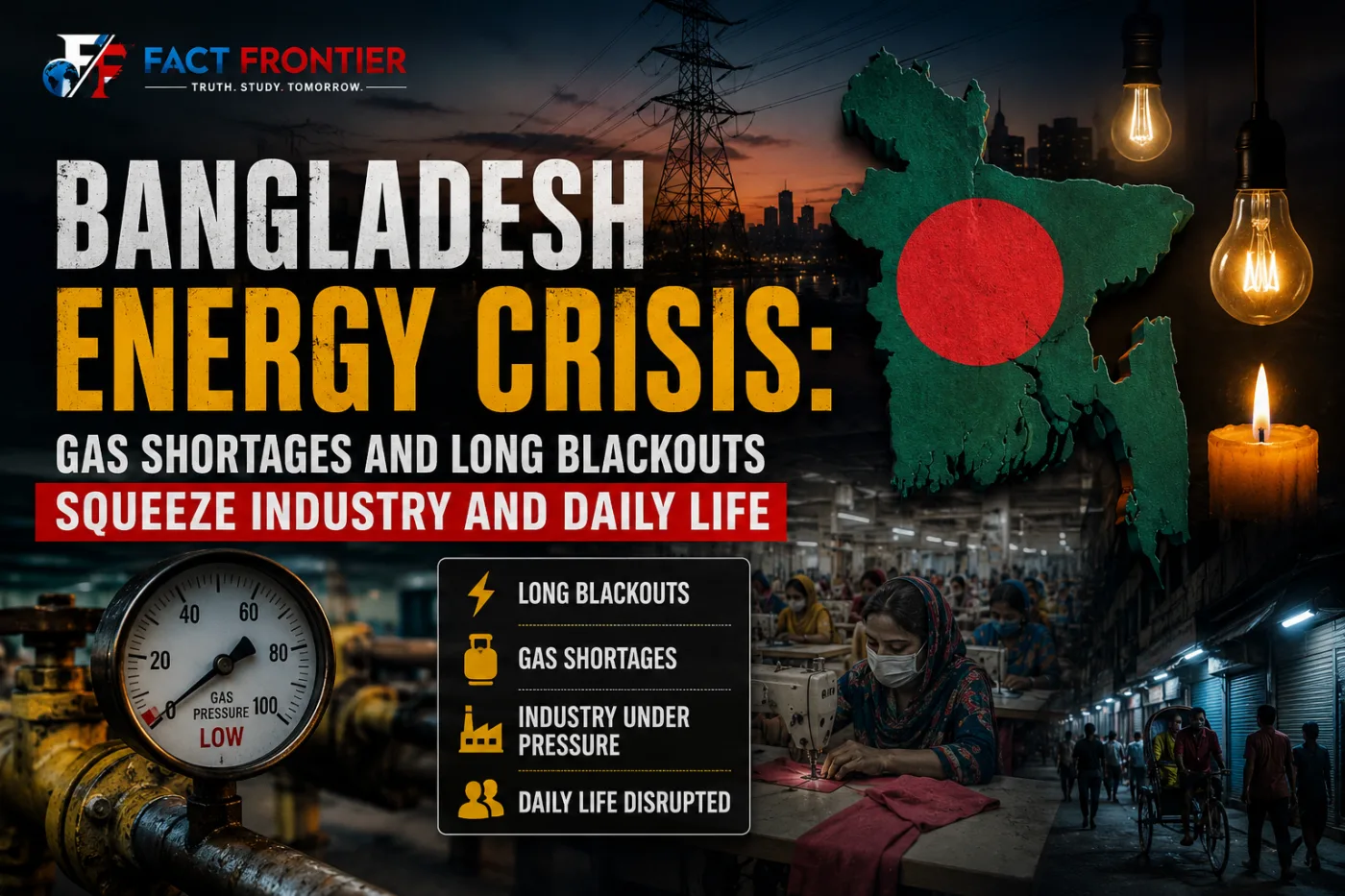
The Bangladesh energy crisis has deepened significantly across the country, triggering rolling 10-hour blackouts, idle power plants, and emergency 8:00 PM retail curfews.
What began as localized load-shedding has escalated into an acute national fuel shortage, forcing the newly formed BNP administration into immediate crisis management as households, public transport, and export-oriented garment factories struggle to keep running.
Gas pressure across the national transmission network has collapsed to roughly half of domestic demand. Power plants across the country are shutting down or throttling output because there is simply nothing to burn in their boilers and turbines. At the same time, queues at compressed natural gas (CNG) stations stretch for blocks, textile mills are struggling to keep their sewing lines running, and rural power distribution offices are calling for armed police protection as public anger turns hostile.
The administration insists the crisis is temporary, driven by an unfortunate mix of offshore infrastructure damage, bad weather in the Bay of Bengal, and soaring global import prices. But on the ground, the economic disruption is immediate, tangible, and rapidly becoming a major political liability for the new government.
The Anatomy of a Fuel Collapse: A Broken Supply Chain
At the core of Bangladesh’s ongoing blackout crisis is an acute, systemic shortage of natural gas. For decades, the country’s power grid, industrial backbone, and domestic transport system were built almost entirely around domestic gas extraction from the eastern basins. As those legacy fields naturally depleted over the past decade, successive policies shifted the burden onto imported Liquefied Natural Gas (LNG).
When imported LNG flows smoothly, the system barely manages peak summer demand. When the import infrastructure stumbles, the entire national grid falters almost instantly.
According to Petrobangla and the power ministry’s operational data, total gas supply delivered to the national transmission grid has fallen to approximately 1,900 million standard cubic feet per day (MMcf/d)—a steep drop relative to a baseline national demand of nearly 3,800 MMcf/d.
The current bottleneck can be traced directly to July 21, when a fire broke out near the subsea and topside electrical systems of Excelerate Energy’s Floating Storage and Regasification Unit (FSRU) moored off the coast of Moheshkhali. The facility, which usually feeds around 450 to 500 MMcf/d of regasified LNG into the Chittagong-Dhaka pipeline, was knocked entirely offline.
While repair crews managed to partially restore one regasification train earlier this month—reintroducing about 115 MMcf/d into the system—the terminal has not been able to run at full capacity. Making matters worse, a series of low-pressure systems and rough seas in the Bay of Bengal over the past two weeks repeatedly delayed the berthing and offloading of incoming spot LNG carriers. With the supply buffer gone, overall daily gas deliveries to power stations and industrial belts dropped to a three-week low.
Daily dispatch records released by Power Grid Bangladesh (PGB) indicate that over 40% of national generating units are either offline or running with restricted output due to severe fuel constraints.
Power Plants Idled, Grid Strained
The impact on power generation has been swift and brutal.
According to operational logs from Power Grid Bangladesh (PGB), fuel shortages have compromised output at 62 of 143 major generation units nationwide. Gas-fired turbines make up the vast majority of the idle capacity, but liquid-fuel (furnace oil and high-speed diesel) and coal-fired plants are also running under heavy operational limits due to procurement backlogs and high import costs.
With thousands of megawatts knocked out of the daily generation mix, the gap between peak evening demand (consistently hovering above 15,500 MW in the August heat) and actual supply has ballooned. Grid operators have had no choice but to enforce severe, unscheduled load-shedding.
In major cities like Dhaka and Chittagong, power cuts are being staggered in two-to-three-hour intervals, interrupting office workflows, freezing domestic water pumps, and forcing high-rise buildings to burn expensive diesel in backup generators.
In peri-urban and rural areas managed by the Palli Bidyut Samities (PBS), the cuts are far more continuous. In parts of Mymensingh, Rangpur, Comilla, and Barisal, residents report getting electricity for only six to eight hours a day, mostly broken up into erratic 45-minute bursts.
The outages have crippled local cold storage facilities, interrupted schooling and online university lectures, and left small workshops without the consistent voltage required to run heavy machinery.
Transport Bottlenecks and Empty CNG Pumps
The fuel crunch has not stopped at the electricity meter; it has spilled directly onto the streets.
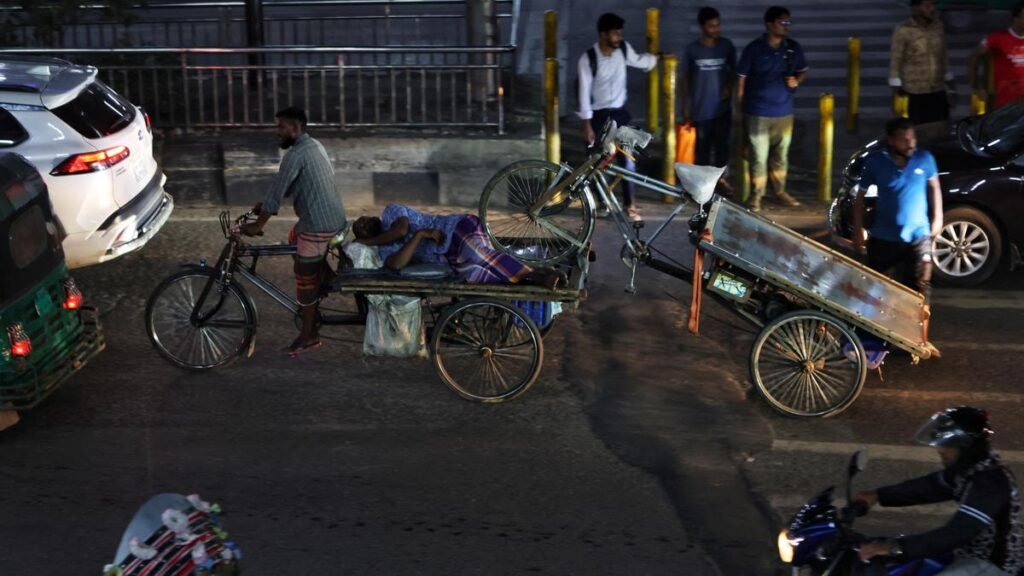
In industrial districts such as Narayanganj, Gazipur, and Savar, pipeline pressure has dropped so low that commercial CNG filling stations cannot compress the gas into vehicle cylinders. Across Narayanganj’s central thoroughfares this week, hundreds of auto-rickshaws, microbuses, and delivery trucks formed queues stretching over two kilometres, with drivers waiting up to ten hours just to get half a tank of fuel.
“I stood in line at the pump from 3:00 AM until noon, only for the station operator to tell us the compressor tripped because pressure fell below 5 psi,” said Mohammad Rafiq, an auto-rickshaw driver in Chasara. “If I cannot fill gas, I cannot take passengers. If I do not take passengers, my family does not eat that night.”
With a large portion of public transport and intra-city logistics running on CNG, the shortages are driving up local transport fares, slowing down produce deliveries to city wholesale markets, and adding friction across regional supply chains.
Industrial Fallout: Garments, Textiles, and Exports
For Bangladesh’s export-oriented manufacturing sector—most notably the ready-made garment (RMG) and textile industries that account for more than 80% of the country’s export earnings—the energy crisis could not have come at a worse time.
Garment factories require uninterrupted gas pressure to run boilers for washing, dyeing, and finishing fabrics, as well as steady electricity to power sewing floors. Without adequate gas pressure, factory operators are forced to switch over to captive diesel generators, which drives up production costs by three to four times per unit of output.
Several factory managers in the Ashulia and Gazipur export belts confirm they have had to turn to night shifts or cut daily output targets, raising fears of missed shipment deadlines for European and North American buyers.
“We are running on razor-thin delivery windows,” said a factory director with operations in Tongi. “When power cuts hit in the middle of a shift and the boiler pressure drops, fabric lots get ruined in the dyeing vats. We cannot operate a competitive export business when basic utilities are this erratic.”
Emergency Decrees: The 8:00 PM Shutdown
Faced with a widening generation shortfall, the BNP government took decisive administrative action earlier this week, announcing a nationwide energy conservation directive.
Under the new orders issued by the power and commerce ministries:
- 8:00 PM Mandatory Commercial Closure: All shopping malls, retail markets, department stores, and neighbourhood shops must pull their shutters down by 8:00 PM sharp.
- 7:00 PM Advertising Blackout: All illuminated outdoor billboards, neon signs, and decorative building facades must be switched off by 7:00 PM.
- Exemptions: Essential emergency services—including pharmacies, government and private hospitals, diagnostic centres, fire stations, and select food outlets—are permitted to operate under normal hours.
The decree represents a notable step up from previous regulations, which allowed shops to trade until 9:00 PM.
While energy planners argue that shutting commercial establishments an hour earlier shaves off hundreds of megawatts of non-essential lighting load during the crucial 7:00 PM to 11:00 PM evening peak, the decision has drawn fierce backlash from the retail business community.
In commercial hubs like Dhaka’s Gausia Market and Elephant Road, shop owners argue that the 7:00 PM to 9:30 PM window represents their most lucrative trading period, when office workers and families shop on their way home. Cutting that window short directly hits daily turnover, making it harder for small traders to cover rent, utility bills, and staff wages.
The present bottleneck traces back to July 21, when an electrical fire damaged the Excelerate Energy Moheshkhali FSRU, taking roughly 450 million cubic feet per day of gas regasification capacity offline.
Rising Public Anger and the Battle for the Grid
As the heat persists and power cuts drag on, public frustration is spilling over into open protest, turning the technical energy shortfall into an immediate public safety and political problem.
In several rural upazilas, angry crowds have gathered outside local Palli Bidyut offices to demand explanations from station managers, with some demonstrations escalating into road blockades and tyre-burning protests.
The tension has grown severe enough that the central leadership of the Bangladesh Palli Bidyut Association formally requested the Home Ministry and local district administrations to deploy police and security forces around key electrical substations, control rooms, and regional utility offices to prevent vandalism and physical confrontations.
Political opponents have wasted no time capitalising on the situation. Jamaat-e-Islami Secretary General Mia Golam Parwar issued a statement sharply criticising the government’s crisis response, calling the rolling blackouts and gas supply failures evidence of administrative mismanagement that is hurting working-class families and students preparing for national exams.
For Tarique Rahman’s administration, the political stakes are high. Having taken office amid high public expectations for governance reforms, economic recovery, and improved public service delivery, the government cannot afford to let prolonged utility failures dominate public perception during its first months in power.
Emergency Procurements and the Indian Fuel Line
Inside the corridors of the Energy and Mineral Resources Division, officials are working through emergency channels to secure fresh fuel supplies and plug the immediate deficit.
To secure spot supplies on the open market, the government recently cleared emergency purchases of imported LNG, including a spot cargo booked at approximately $22.35 per million British thermal units (MMBtu)—a steep price that places heavy pressure on the country’s foreign exchange reserves, but one deemed necessary to prevent grid collapse.
To stabilise deliveries over the medium term, the cabinet committee on procurement has also formally signed off on a long-term supply agreement with US-based energy trader Gunvor, covering 117 LNG cargoes scheduled for delivery over a multi-year timeframe. While the Gunvor deal helps establish baseline security for future seasons, it does little to alleviate the immediate shortfalls of the current week.
On the liquid-fuel front, Dhaka has turned to its immediate neighbour. Senior energy ministry officials confirmed that Bangladesh has reached out to India to fast-track additional shipments of high-speed diesel (HSD) via the India-Bangladesh Friendship Pipeline (IBFP) and cross-border rail tankers. The extra diesel is intended to feed dual-fuel and liquid-fuel power plants that are currently sitting idle, helping take the pressure off the gas-dependent units.
The Road Ahead: Governance Under Pressure
Energy analysts point out that while emergency fuel purchases and bilateral diesel imports can offer immediate relief, they are expensive, short-term band-aids on a structural problem that has been building for more than a decade.
Bangladesh’s domestic gas production has been steadily declining without sufficient new on-shore or deep-water offshore exploration to replace depleted reserves. At the same time, the state’s heavy reliance on volatile global spot energy markets leaves the national budget exposed whenever Middle Eastern shipping corridors face geopolitical unrest or international LNG benchmark prices surge.
To build genuine long-term resilience, energy economists argue the BNP government must:
- Accelerate domestic exploration: Fast-track bidding rounds for offshore Bay of Bengal gas blocks and fund Petrobangla’s onshore drilling campaigns.
- Upgrade LNG intake infrastructure: Move away from vulnerable offshore FSRU setups toward secure, land-based LNG terminals with better weather protection.
- Diversify into renewables and grid storage: Scale up utility-grade solar and cross-border clean energy imports to reduce reliance on imported fossil fuels.
- Improve inter-agency coordination: Streamline dispatch operations between gas transmission companies, fuel importers, and power distributors to eliminate supply bottlenecks.
For now, the government’s immediate focus remains purely operational: get the Moheshkhali terminal back to full pumping capacity, clear incoming spot cargoes through the port, and ease daily load-shedding before public patience runs out.
For Prime Minister Tarique Rahman, keeping the country’s lights on is no longer just a technical utility challenge—it is the first major test of his administration’s ability to govern under pressure and maintain the confidence of a weary public.
Frequently Asked Questions (FAQs)
Q1: Why is Bangladesh suddenly facing massive blackouts? It all comes down to a crippling natural gas shortage. The country’s power grid runs primarily on gas, and right now, it’s only getting about half of what it needs (roughly 1,900 MMcf/d against a demand of 3,800 MMcf/d). The supply chain snapped in July when a fire knocked out a crucial offshore LNG terminal in Moheshkhali. To make matters worse, rough seas in the Bay of Bengal have delayed incoming emergency fuel ships. With no fuel to burn, over 40% of the country’s power generation units are either offline or struggling.
Q2: How bad are the power cuts on the ground? Brutal, especially outside the capital. While Dhaka and Chittagong are seeing staggered two-to-three-hour cuts, rural districts are enduring 9- to 12-hour rolling blackouts. In many villages, electricity only flickers on in unpredictable 45-minute bursts. The situation is so tense that local rural utility offices have literally asked for armed police protection to fend off angry crowds.
Q3: What is the new BNP government doing to stop the bleeding? They’ve hit the emergency brakes on commercial power use. All shopping malls and retail markets are legally forced to shut down by 8:00 PM, and illuminated billboards must go dark by 7:00 PM. Behind the scenes, the government is scrambling—buying highly expensive emergency spot LNG on the global market, signing a long-term supply deal with US-based Gunvor, and even asking India to rush diesel shipments across the border to fire up idle liquid-fuel plants.
Q4: How is this affecting the economy and jobs? It’s a massive hit. The ready-made garment (RMG) and textile factories—the backbone of Bangladesh’s export economy—are struggling to keep their boilers running. When gas pressure drops, they have to run backup diesel generators, which triples production costs and ruins fabric batches. Meanwhile, transport is freezing up because CNG stations don’t have enough pipeline pressure to fill auto-rickshaws, and small shopkeepers are losing their most profitable evening hours due to the 8:00 PM curfew.
Q5: Is this just a temporary hiccup or a permanent problem? The immediate blackout crisis will likely ease once the Moheshkhali terminal is fully repaired and the weather clears up for fuel ships to dock. However, the root problem is structural. Bangladesh’s domestic gas reserves are drying up, and the country hasn’t done enough offshore drilling. This leaves the entire national grid entirely at the mercy of expensive, volatile global LNG markets. Unless they build better land-based terminals and find more local gas, this kind of crisis will keep repeating.
To prevent future gaps, authorities completed a multi-year fuel framework with Gunvor Group for 117 LNG cargoes while negotiating emergency spot tenders.
Conclusion
For Prime Minister Tarique Rahman’s administration, the energy crisis has stripped away any room for a comfortable transition period.
While the government can point to bad weather, high international fuel costs, and a damaged offshore terminal as immediate triggers, people waiting in 10-hour blackouts and factory owners watching production stall aren’t interested in technical explanations—they want reliable power.
Emergency stopgaps, like rolling shop curfews, spot LNG purchases, and diesel from India, can help keep the grid from total collapse in the short term. But they come at a steep price for both the state budget and the wider economy. If the new leadership wants to avoid turning this utility breakdown into a full-blown political crisis, it will need to move past emergency patches and fix the deeper vulnerabilities: finding more domestic gas, building better onshore infrastructure, and finally reducing the country’s risky dependence on volatile global energy markets.
📚 Verified Research Sources & Fact-Checking Citations
At FactFrontier, every claim is cross-referenced with primary scientific databases, institutional research archives, and verified historical records:
- Nature & Scientific American Archives: Peer-reviewed science and interdisciplinary research publications.
- Encyclopaedia Britannica & Academic Repositories: Verified historical and encyclopedic reference data.
- Global Scientific Fact-Checking Networks: Primary institutional datasets and peer-reviewed literature.