
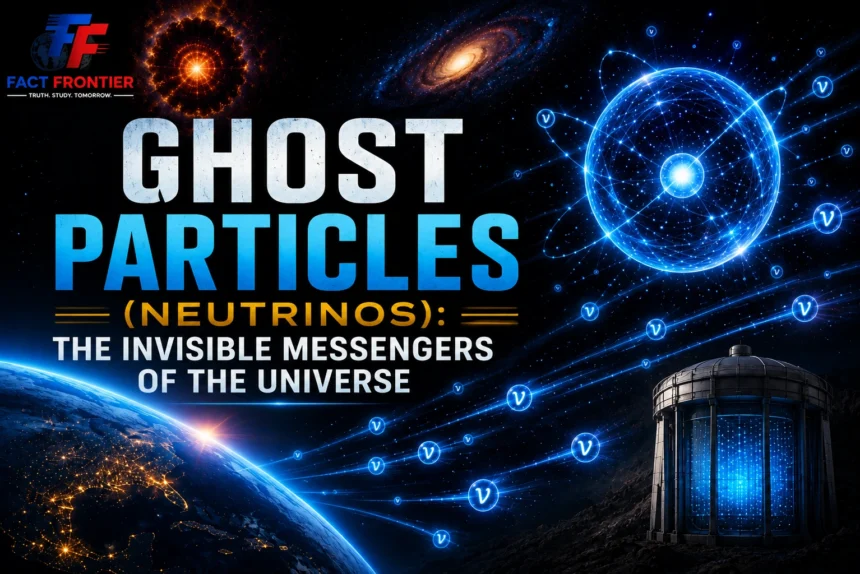
The Universe’s Quietest Travelers
Every second, an invisible stream of particles passes effortlessly through your body, your home, the mountains around you, and even the entire Earth. They leave no trace, make no sound, and almost never collide with anything. Despite being among the most abundant particles in the cosmos, they remained hidden from science for decades.
These extraordinary particles are known as neutrinos, though they are more commonly referred to as Ghost Particles because they behave almost as if matter does not exist.
Unlike light, which can be blocked by walls or absorbed by dust, neutrinos travel across the universe almost uninterrupted. They escape from the cores of stars, emerge from violent supernova explosions, and even carry information from places where light cannot escape. For physicists, they are not merely tiny particles—they are cosmic messengers capable of revealing events that would otherwise remain forever invisible.
Today, neutrino research sits at the frontier of modern physics. From underground laboratories carved into mountains to detectors buried beneath Antarctic ice, scientists are building some of the world’s most sophisticated instruments in an effort to understand these elusive travelers.
A Particle Nobody Could See
The story of neutrinos began with a puzzle.
During the early twentieth century, physicists studying radioactive decay noticed that energy appeared to vanish during certain nuclear reactions. According to one of the most fundamental principles in physics—the law of conservation of energy—this should have been impossible.
Rather than abandon the law, Austrian physicist Wolfgang Pauli proposed a bold solution in 1930. He suggested that an invisible particle was carrying away the missing energy. It was a daring idea because no experiment at the time could detect such a particle.
A few years later, Italian physicist Enrico Fermi expanded Pauli’s idea into a complete theoretical framework and gave the particle its name: neutrino, meaning “little neutral one.”
For more than two decades, neutrinos remained purely theoretical.
Everything changed in 1956 when American physicists Frederick Reines and Clyde Cowan successfully detected neutrinos produced inside a nuclear reactor. Their experiment confirmed one of the boldest predictions in modern physics and opened an entirely new branch of scientific research.
Why Scientists Call Them Ghost Particles
Neutrinos earned their nickname because they interact so weakly with matter.
Most particles constantly collide with atoms as they travel. Photons create light. Electrons produce electricity. Protons build the atoms that make up everything around us.
Neutrinos behave differently.
They carry no electric charge and possess only an extremely small mass. More importantly, they interact only through gravity and the weak nuclear force, making collisions incredibly rare.
As a result:
- Trillions pass through every person each second.
- They travel through entire planets almost undisturbed.
- Even dense stars cannot stop many of them.
- They preserve information from the environments where they were created.
This unusual behavior allows neutrinos to escape directly from places that light cannot, giving scientists a unique way to observe the universe.
Born in the Most Extreme Places
Neutrinos are created in environments where enormous amounts of energy are released.
The Sun
Every second, billions of nuclear fusion reactions occur inside the Sun’s core. These reactions continuously produce neutrinos that stream outward in every direction.
Although sunlight takes thousands of years to travel from the Sun’s core to its surface, neutrinos escape almost immediately and reach Earth in about eight minutes.
This makes them valuable tools for studying the Sun’s interior.
Exploding Stars
When massive stars exhaust their nuclear fuel, gravity causes their cores to collapse, triggering spectacular explosions known as supernovae.
Almost all of the energy released during such explosions leaves the star in the form of neutrinos.
In 1987, detectors around the world observed neutrinos arriving from Supernova 1987A, providing direct evidence of processes occurring deep inside an exploding star long before telescopes captured its brightest light.
That event marked the beginning of neutrino astronomy, a field that allows researchers to observe the universe through particles rather than light.
Earth’s Atmosphere
Neutrinos are also produced much closer to home.
High-energy cosmic rays constantly strike Earth’s atmosphere. When these particles collide with atmospheric molecules, they generate cascades of secondary particles, including neutrinos.
These atmospheric neutrinos have become essential for studying one of the most surprising discoveries in particle physics: neutrino oscillation.
Human Technology
Nature is not the only source of neutrinos.
Nuclear reactors produce enormous numbers of antineutrinos during nuclear fission. These artificial sources have allowed physicists to conduct carefully controlled experiments, helping them measure neutrino properties with increasing precision.
Three Faces of the Same Particle
One of the most fascinating characteristics of neutrinos is that they come in three distinct flavors:
- Electron neutrino
- Muon neutrino
- Tau neutrino
At first, scientists believed these were separate particles that remained unchanged throughout their journey.
Experiments later revealed something extraordinary.
Neutrinos can transform from one flavor into another while traveling through space.
This phenomenon, known as neutrino oscillation, demonstrated that neutrinos possess a tiny—but non-zero—mass.
The discovery challenged the Standard Model of particle physics, which originally assumed neutrinos were massless. It also earned the 2015 Nobel Prize in Physics, recognizing the profound significance of this breakthrough.
More Than Just Tiny Particles
Modern astronomy increasingly relies on “multi-messenger” observations. Instead of studying the universe using only visible light, scientists combine information from electromagnetic radiation, gravitational waves, cosmic rays, and neutrinos.
Each messenger tells a different part of the cosmic story.
Neutrinos are especially valuable because they travel almost undisturbed across billions of light-years, carrying pristine information from the most energetic events in the universe.
Whether they originate inside the Sun, an exploding supernova, or a distant active galaxy, these particles arrive at Earth as silent witnesses to events that occurred millions—or even billions—of years ago.
For physicists, every detected neutrino represents a rare opportunity to glimpse processes hidden deep within the universe.
Chasing the Most Elusive Particle in Nature
Detecting a neutrino is often compared to trying to catch a single grain of sand drifting through an entire continent. That comparison may still underestimate the challenge.
Neutrinos interact with matter so rarely that billions pass through every square centimeter of Earth every second without leaving a measurable trace. To improve the chances of detecting even a handful of them, scientists build enormous observatories deep underground, beneath oceans, or inside thick Antarctic ice. These remote locations shield detectors from cosmic radiation and other background particles that could interfere with measurements.
Rather than observing neutrinos directly, researchers watch for the tiny flashes of light created when a neutrino occasionally collides with an atomic nucleus. These flashes, known as Cherenkov radiation, last only a fraction of a second but contain valuable information about the particle’s energy, direction, and origin.
Each successful detection is a rare event—one that can provide clues about the deepest workings of the universe.
The World’s Largest Neutrino Experiments
Over the past few decades, several international collaborations have transformed neutrino physics into one of the fastest-growing fields in science.
IceCube Neutrino Observatory – Antarctica
Hidden beneath nearly 1.5 kilometers (about one mile) of Antarctic ice lies the IceCube Neutrino Observatory, the world’s largest neutrino detector.
Instead of using traditional telescopes, IceCube relies on more than 5,000 digital optical sensors frozen inside exceptionally clear ice. When a high-energy neutrino collides with an atom in the ice, it produces a faint burst of blue Cherenkov light. The detector records these flashes, allowing scientists to reconstruct the particle’s path.
IceCube has opened a completely new window into the cosmos by detecting neutrinos originating far beyond our galaxy. These observations have helped identify some of the universe’s most energetic environments, including active galaxies powered by supermassive black holes.
Unlike conventional telescopes, IceCube can observe regions hidden behind dense clouds of gas and dust, making it an invaluable tool for modern astronomy.
Super-Kamiokande and Hyper-Kamiokande – Japan
Japan has played a central role in neutrino research for decades.
The Super-Kamiokande Observatory, located beneath Mount Ikeno, contains an enormous tank filled with ultra-pure water surrounded by thousands of highly sensitive photomultiplier tubes.
It was here that scientists gathered convincing evidence for neutrino oscillation, proving that neutrinos change flavor as they travel.
Building on that success, Japan is developing Hyper-Kamiokande, an even larger detector expected to provide unprecedented precision in studying neutrino behavior.
Researchers hope Hyper-Kamiokande will answer several long-standing questions, including whether neutrinos and antineutrinos behave differently—a phenomenon that could help explain why the universe contains far more matter than antimatter.
DUNE – The Next Generation Experiment
One of the most ambitious international scientific projects currently under construction is the Deep Underground Neutrino Experiment (DUNE) in the United States.
DUNE will send an intense beam of neutrinos from Fermilab in Illinois to detectors located nearly 1,300 kilometers away in South Dakota.
Because neutrinos can travel straight through Earth’s crust without tunnels or pipes, scientists can observe how they transform during this long journey.
The project is designed to answer several fundamental questions:
- What is the exact ordering of neutrino masses?
- Why does matter dominate over antimatter?
- Could physics exist beyond the Standard Model?
- How do massive stars explode?
The experiment also aims to detect neutrinos from future supernova explosions occurring anywhere within our galaxy.
JUNO – China
China’s Jiangmen Underground Neutrino Observatory (JUNO) represents another major milestone in neutrino research.
Its enormous liquid scintillator detector is designed to measure neutrino oscillations with exceptional precision.
By improving measurements of neutrino mass differences, JUNO could help resolve one of particle physics’ most persistent mysteries: the neutrino mass hierarchy.
Because of its remarkable sensitivity, JUNO is also expected to contribute to studies of supernova neutrinos and natural radioactivity inside Earth.
Recent Discoveries Are Expanding the Frontier
Neutrino research continues to advance rapidly.
The IceCube Collaboration has now accumulated more than a decade of observations, enabling scientists to identify increasingly distant cosmic neutrino sources.
Researchers have also begun combining neutrino observations with gravitational-wave detectors and traditional telescopes. This “multi-messenger astronomy” approach allows scientists to study the same cosmic event using different types of signals, creating a far more complete picture of extreme phenomena such as neutron star mergers and active galaxies.
Meanwhile, experiments at the Large Hadron Collider (LHC) have successfully observed high-energy neutrinos produced during proton collisions. These measurements provide new opportunities to study neutrino interactions under controlled laboratory conditions.
Future observatories are expected to detect neutrinos with even greater precision, potentially revealing entirely new physics beyond current theories.
India’s Contribution to Neutrino Science
India has a long history of involvement in neutrino research.
One of the country’s earliest achievements came in 1965, when scientists working in the Kolar Gold Fields recorded atmospheric neutrinos—among the earliest such observations anywhere in the world.
Building on that legacy, Indian researchers proposed the India-based Neutrino Observatory (INO).
The project aims to establish a state-of-the-art underground laboratory equipped with a massive Iron Calorimeter (ICAL) detector capable of studying atmospheric neutrinos.
Although environmental clearances and administrative challenges have delayed construction, Indian physicists continue contributing to international collaborations involving CERN, DUNE, and other major neutrino experiments.
If completed, INO would strengthen India’s position as an important participant in global particle physics research.
Could Neutrinos Rewrite Modern Physics?
For decades, the Standard Model has successfully explained most known elementary particles and forces.
Yet it leaves many important questions unanswered.
Neutrinos may provide the missing pieces.
Scientists are investigating whether neutrinos violate CP symmetry differently from other particles. If confirmed, this could help explain why the universe contains matter at all instead of equal amounts of matter and antimatter.
Researchers are also searching for evidence of sterile neutrinos—a hypothetical type of neutrino that would interact even more weakly than ordinary neutrinos.
No confirmed evidence has yet been found, but ongoing experiments continue exploring this possibility.
Another major goal is determining the absolute mass of neutrinos, one of the remaining unknown parameters in particle physics.
Any breakthrough in these areas would require significant revisions to existing theories.
Why Ghost Particles Matter Beyond Physics
Although neutrinos are fundamental particles, their importance extends far beyond theoretical research.
They help scientists:
- Monitor nuclear reactors for non-proliferation studies.
- Observe the internal processes of the Sun.
- Investigate exploding stars before visible light arrives.
- Study cosmic rays and energetic galaxies.
- Improve our understanding of the evolution of the universe.
- Explore conditions that existed only seconds after the Big Bang.
Because neutrinos travel almost undisturbed across enormous cosmic distances, they carry information unavailable through any other known messenger.
In many ways, they function as nature’s most reliable long-distance reporters.
The Road Ahead
The coming decade promises to be one of the most exciting periods in neutrino research.
Hyper-Kamiokande, DUNE, JUNO, IceCube-Gen2, and several other international experiments are expected to deliver increasingly precise measurements that could reshape our understanding of particle physics.
Scientists hope to answer questions that have persisted for generations:
- How much do neutrinos actually weigh?
- Are neutrinos their own antiparticles?
- Why did matter survive after the Big Bang?
- Is there new physics beyond the Standard Model?
- Could neutrinos help explain dark matter?
Every new observation brings researchers one step closer to solving these mysteries.
A Silent Messenger with an Extraordinary Story
Neutrinos rarely interact with the universe around them, yet they may hold the key to understanding how the universe itself came into existence.
They travel through stars, planets, galaxies, and even our own bodies without slowing down, carrying untouched information from places that light can never reveal.
For nearly a century, these “ghost particles” have challenged scientific assumptions, inspired groundbreaking experiments, and reshaped our understanding of fundamental physics. Their discovery demonstrated that even the smallest particles can overturn long-held theories.
As the next generation of detectors begins operation, neutrinos are poised to reveal even more about the hidden workings of the cosmos. The answers they carry may not only explain the universe’s past but also redefine the future of modern science.
Fact Box 1: Neutrinos at a Glance
| Property | Details |
|---|---|
| Scientific Name | Neutrino |
| Nickname | Ghost Particle |
| Electric Charge | Neutral (0) |
| Mass | Extremely small but not zero |
| Speed | Close to the speed of light |
| Interacts Through | Weak Nuclear Force & Gravity |
| First Proposed | 1930 (Wolfgang Pauli) |
| First Detected | 1956 |
| Nobel Prize | 2015 (Neutrino Oscillation) |
Fact Box 2: Did You Know?
✔ Around 100 trillion neutrinos pass through your body every second.
✔ Most of them come directly from the Sun.
✔ Neutrinos can pass through the entire Earth almost without interacting.
✔ They were predicted 26 years before scientists detected them.
✔ Some neutrinos have traveled billions of light-years before reaching Earth.
Fact Box 3: Myth vs Fact
Myth:
Ghost Particles are dangerous radiation.
Fact:
Neutrinos are completely natural and harmless. They pass through our bodies continuously without causing damage.
Myth:
Scientists can easily detect neutrinos.
Fact:
Neutrinos are among the hardest particles to detect because they rarely interact with matter.
Myth:
Only the Sun produces neutrinos.
Fact:
Neutrinos also come from supernovae, Earth’s atmosphere, nuclear reactors, the Big Bang, and some of the most energetic galaxies in the universe.
Fact Box 4: Timeline of Major Milestones
| Year | Event |
|---|---|
| 1930 | Wolfgang Pauli proposes the neutrino |
| 1934 | Enrico Fermi develops neutrino theory |
| 1956 | First experimental detection |
| 1987 | Supernova 1987A neutrinos detected |
| 1998 | Evidence of neutrino oscillation |
| 2015 | Nobel Prize awarded for neutrino oscillation |
| Present | IceCube, JUNO, DUNE & Hyper-Kamiokande advancing neutrino science |
Key Takeaways
- Neutrinos are elementary particles with no electric charge.
- They interact only through the weak nuclear force and gravity.
- Trillions pass through every human every second.
- They originate from the Sun, supernovae, cosmic rays, nuclear reactors, and the early universe.
- Neutrino oscillation proved they have mass, changing modern particle physics.
- Observatories such as IceCube, JUNO, Hyper-Kamiokande, and DUNE are expanding our understanding of the cosmos.
- India’s proposed INO project aims to strengthen the country’s role in neutrino research.
- Future discoveries may answer fundamental questions about matter, antimatter, and the origin of the universe.
Frequently Asked Questions (FAQs)
1. What are Ghost Particles?
Ghost Particles are neutrinos—tiny, electrically neutral elementary particles that interact extremely weakly with matter.
2. Why are neutrinos called Ghost Particles?
Because they pass through most matter almost without interacting, making them appear almost invisible.
3. Can neutrinos pass through Earth?
Yes. Most neutrinos travel straight through Earth without being absorbed.
4. Are Ghost Particles dangerous?
No. They are naturally occurring particles that pass harmlessly through living organisms.
5. Who discovered neutrinos?
Wolfgang Pauli predicted their existence in 1930, while Frederick Reines and Clyde Cowan experimentally detected them in 1956.
6. How do scientists detect neutrinos?
Scientists use enormous underground, underwater, or under-ice detectors that capture rare flashes of Cherenkov radiation produced when a neutrino interacts with matter.
7. Why are neutrinos important?
They provide information about the Sun, exploding stars, distant galaxies, and conditions shortly after the Big Bang.
8. What is neutrino oscillation?
It is the process in which neutrinos change between electron, muon, and tau flavors while traveling.
9. Does India have a neutrino observatory?
India has proposed the India-based Neutrino Observatory (INO), which is intended to study atmospheric neutrinos once completed.
10. Can neutrinos explain dark matter?
Current evidence does not show that known neutrinos make up dark matter, but scientists continue exploring whether additional types of neutrinos or related physics could play a role.
📚 Verified Research Sources & Fact-Checking Citations
At FactFrontier, every claim is cross-referenced with primary scientific databases, institutional research archives, and verified historical records:
- Nature & Scientific American Archives: Peer-reviewed science and interdisciplinary research publications.
- Encyclopaedia Britannica & Academic Repositories: Verified historical and encyclopedic reference data.
- Global Scientific Fact-Checking Networks: Primary institutional datasets and peer-reviewed literature.